Tour de France watching for breakfast – totally guilt free!

I have been trying to get my head round watching the Tour de France from British Columbia. Particularly this year because of the British interest with Wiggins and Cavendish. So I just sat down with the official Tour web site and the trusty time zone calculator to discover that Wiggo should be donning the yellow jersey for the first time around 8.30 am tomorrow.*

And after that the stage finishes should all be around the same time each day. Amazing – able to watch the sport without the slightest guilt that I am wasting the day, not sold out because I am watching not riding, not having to do the ironing to justify watching sport all afternoon. And then I can go ride my bike afterwards.

Yippee!

*Over-optimism may be creeping in with the joy of this discovery.

Tour de France at the Halfway Inn, Kent, England

Tour de France at the Halfway Inn, Kent, England

Olympic cycling………..the good, the bad and the downright bloody stupid

The good

I finally landed some Olympic cycling tickets today. No tickets for the men’s road race viewing areas on Box Hill but at least some for the Sunday to watch the womens. First cycling tickets I have even had a sniff of despite “investing” a significant fortune in the lottery for the velodrome tickets last year.

The bad

Being forced to cough up to stand on a road and watch cycling. I know I’m late in my rant, but at the time all this blew up I was working for CTC and it might not have been politically acceptable for the CEO of a rival/partner (delete as appropriate)  body to our racing organisation to go ballistic over the fact that he couldn’t take his family to the prime spot for cyclists at the Olympics. No such constraints now.

How could anybody involved not know it would be a problem? Why not move the course to somewhere that can be watched by real cycling fans who were frozen out by all the corporates at the Velodrome? They had time. Only in Britain would cycling be reduced to this. Imagine telling the population of Paris that they wouldn’t be able to watch the cycling if they had won the blasted jamboree instead of us.

I love Box Hill – it is a great spot, I have cycled, walked and mountain biked round it. I know it needs to be preserved. So move the race, not remove the people.

The downright bloody stupid

Thanks to the CTC newsletter popping into my in-box on Friday I was able to give my new Brussels colleagues the benefit of some public ranting.

“Train companies to ban cycles during Olympics”.

Thats it. Every train operator who serves any station remotely useful for getting to the cycling has banned bikes for the weekend. I live 30 miles from any viewing point. I had hoped some younger relatives and also less “cycle-mad” adults would be coming out with us to enjoy their only chance to sample 9 billion pounds worth of our money. Chance of a lifetime? Fat chance!

Probably get a lawyer’s letter now for using the word “Olympic” without permission. Perhaps “Olymprics” could become the new name for the officials?

Going down……..

I was browsing yesterday when I found this video on the Charlie Bucket Cycles blog. It caught my eye because it features the Stelvio – the key climb in the Giro d’Italia which has just finished. It just made me smile.

And then with the magic of Youtube you are prompted by another link about going downhill. It is the most amazing sequence. Not just the extraordinary skill of perhaps the finest descender we have ever seen. But give credit to the motorcycle team who had to do this with a pillion rider on the bike and to the producer who at some moment decided just to let the sequence run – for almost the whole seven minutes.

If you regard yourself as disinterested in cycle racing – perhaps a pure cycle commuter – I suggest you watch this and imagine. At some time this chap is going to retire from racing. Can you see him riding to work in a traffic jam near you?

Books and reflections – Eddie Merckx and Beryl Burton

As I mentioned in posts at the time two of the greatest cycling names in history crossed my path recently. I was given a new biography of Merckx as a “going to Belgium gift” by Brian and Marjike and I heard about a possible play about the life of Beryl Burton in the same week.

There was something in the insatiable desire of Merckx that reminded me of Burton’s appetite for racing so I decided to re-read of Beryl’s autobiography “Personal Best”, both as a comparison and a reflection of two riders from the same period.

Without a shadow of doubt William Fotheringham’s “Half Man, Half Bike” is the better read. He is a professional journalist with a good eye for a story but also the variety and competitiveness of international pro bike racing means there is so much more in the content. It is also much more accessible to a wider audience because pro bike racing gets much more media coverage these days. Beryl was above all else a specialist in the very British branch of time trialling. It has a character all of its own, but it is not exactly a thrill a minute sport and Beryl was so dominant far too much of the book reads like a catalogue.

Personal Best - Beryl Burton CoverIn “Personal Best” only editor Colin Kirby really speculates on what made Beryl special. William Fotheringham spends more of his time trying to understand why Merckx just had to win every week, but without ever really getting to the bottom of this driven personality.. And what neither book can tell is what made them the athletes they became. Is there a link to illness as a child, especially in Beryl’s case? One can’t help but recall that Lance Armstrong was good but not great before his recovery from cancer. Today sports science would intervene and give us some juicy titbits, like the lung capacity and low pulse rate of Miguel Indurain or the power output of Mark Cavendish.

Also what I hadn’t realised until I read both books side by side is just how many injuries both were dealing with. If the ability to push yourself to the athletic limit is linked to an ability to overcome pain thresholds then perhaps we have found the common thread that binds them? For now we largely have the results of both careers, and a hint that winning was as much mental as physical with these greats.

I enjoyed re-reading “Personal Best” much more than I expected. In 1986 I did find it a bit boring and I am not sure I really can recommend it as a great read to anyone outside time trialling, other than as a curiosity. But reading it this time I felt both nostalgia for a lost time and a deeper recognition of just how great this athlete really was. I hope the radio play about her life comes off and really manages to capture the essence of the BB story, I for one shall be watching out for it eagerly.

Personal Best – reflections

(Eddie Merckx “Half man, half bike” review to follow in a few days.)

On opening my copy of “Personal Best” there is a handwritten message: “Sept ’86 – she’s an inspiration to us all. – Dad.” On the occasion of my 25th birthday this book was important enough for my father to make this my present, knowing I would understand the message.

Only in the closed world of British time trialling could the legendary status of Beryl Burton truly be understood. Forget the time trials you see on the television for the world champs or at the grand tours. This was a sport that grew up with a very different heritage, a sort of parallel evolution to all other forms of cycling. In the early part of the twentieth century a group of wise men decided that continental style mass start racing was too much for the British public to bare and it had to be killed off. The only way racing on the highway could be considered was to have secret meeting points early in the morning where discrete cyclists carefully dressed in black would ride off at one minute intervals to compete on time over fixed distances. There was also thinly disguised snobbery for the fancy tactics of the continentals, this pure art of time trialling was about speed only.

In the narrow confines of time-trialling world there is no “hand to hand” combat where cyclists could use skill and tactics to ride against each other, it is power in its most pure form. While the sport had moved away from its secret identity by Beryl’s time it was still a relatively narrow world, but it commands a significant cycling community in the UK. Even today there is hardly a racing cyclist who hasn’t at least tried the shortest of all the time trialling distances – 10 miles – and knows their own PB, hence the title of the book “Personal Best”, a shared code.

This makes time trialling very inclusive. Everybody here understands the search for those elusive seconds that could give a new PB or set the fastest time for your club, district or country this year. They can also measure exactly in seconds, minutes or miles exactly just how good the champions of the sport really are. I know the time and place of all my personals, and just how slow I really was! And up to the 1970s the races were also a shared experience. Up to 120 riders of all abilities could set off and have the same experience of the course and the conditions. The champions are scattered through the field so the mere mortals will see them whizz by at regular intervals. Later greater use of cars enabled the faster riders to travel the country seeking fast times and keep the lesser performers off many of the fast courses, but in the 1960s it was still a real melting pot. In preparing this post I was looking at some recently scanned photos from our family album and I suddenly realised that this grainy shot from the Isle of Man Cycling festival in 1966 just sums it up. Isle of Man Cycling Festival 1966 Time Trial Start

My Mum is on the start line ready to ride a festival time trial in what must have been her first ever season of racing. And I think waiting to start just one minute behind her is none other than Beryl Burton.

Beryl belonged to this community, she was their icon, their champion – and all the more accessible for being a Yorkshire housewife who worked on a rhubarb farm and was largely untouched by celebrity. She had come into this closed world as a young Yorkshire woman who won her first race in 1956. By the time her autobiography was written in 1986 we didn’t know she had just won her last solo national title but she had been at the top of the sport for nearly 30 years. She not only won women’s races by enormous margins but then started beating the men. There was not a time trialist in the country who couldn’t measure just how good she was against their own times. Some of the earliest times I can recall are being carried out of the house in the dark to a waiting car because Daddy or Mummy had a race. Hours later we would wake up in some god-forsaken layby where the time trial had taken place. And whenever I might ask “who won?” the answer for the women’s race would always be Beryl, and indeed many of the men’s races.

To cap it all was the legendary 1967 Otley 12 hour. In time trialling the Brits race up to 12 and 24 hours each year to see who can cover the greatest mileage. In 1967 Beryl did what no other woman in athletic history has achieved in any sporting discipline. She not only beat the men’s winner on the day but she broke the national men’s record, completing 277 miles (449km) in 12 hours. I was only 6 years old at the time so I don’t have any recall of it as news but I somehow felt I was part of that time. Back to the family archive and I discovered the result sheet from the 100 mile championship of the year which has one of my favourite family cycling photos.

National Women's 100 mile Time Trial Result Sheet 1967

National Women’s 100 mile Time Trial Result Sheet 1967

Beryl dominant as ever, but 30 women finished the event, not least a novice riding her first ever 100 mile TT. I know I was being carted around such events at the time in the back of the support car so I guess I just absorbed the memories.

If the UK cyclists win medals at the Olympics this year it will be great, but it would be a much fairer test of their greatness if they were pitching against the five or six Gold Medals that should have been won by BB. “Personal Best” is a better book when it ventures off into the more exciting world of road racing and foreign trips such as world championships where she came up against the Belgians, Dutch and the machine that was Russian women’s sport in the 1960s and 70s. But Beryl’s frustrations with the lack of reward for pure effort show too, here was a world in which should couldn’t win every year with pure Yorkshire grit, but her haul of seven world championships is truly incredible. Sadly all women’s racing was excluded from the Olympics until the 1980s and even then a time trial was not included until much more recently. Had it been there is little doubt Beryl would have had far greater national prestige outside the cycling world.

The book quotes a French commentator in the opening line of the forward which sums it up. Maybe not the greatest book, but the greatest female cyclist we have ever seen:

“If Beryl Burton had been French Joan of Arc would have to take second place.”

Giro D’Italia more fun than the The Tour?

After last year’s brilliant Tour de France I really thought the event had got its mojo back – best in years.

But I have to say for consistent excitement the Giro organisers seem to come up with the goods regularly and the riders respond with attacking riding almost every day. Can’t wait for tomorrow, the event going in to the final time trial genuinely in the balance.

I loved stages like the day into Assisi, those short sharp uphill finishes into the old cities and towns make the race. I just can’t imagine the Tour de France going into a place where the streets are so narrow there was room for just one rider, rewarding the bold, but creating narrow margins that change almost daily.

And today – just a brilliant ride by the new Belgian star De Gendt over an astonishing course. I wish I could read the Flemish papers when I get back to Brussels, but I guess I’ll be able to pick it up from the headlines and pictures. Shame Cav has lost the red jersey by a point – lost it all on the day that he was brought down in the bunch.

Bring it on………..

“So long, and thanks for all the fish”*

While I have been on holiday for the last couple of weeks I have been trying to summarise my thoughts about leaving CTC, and asking myself if it is fair to them (and me) to comment while looking back.

But then tonight I read a quote from Eddie Merckx in William Fotheringham’s new book “Half man, half bike” Half man, half bike book cover

 “When something is your passion and you can make it into your profession that is the most beautiful thing anyone can have”

So not only was he the greatest cyclist we have ever seen, this man of Belgium produced a quote that sums up far better than my mumblings what I tried to say to the Council, staff and members of CTC in various forums as I left.

When I was a kid I had Eddie Merckx posters on my wall alongside the 1970s stars of Ipswich Town FC, he was a godlike figure. And while it was quickly clear that this spindly asthmatic kid was never going to be a top bike racer I could dream a bit. And in 1998 CTC gave me that chance to be a professional cyclist in my own way, to have what Merckx calls the “most beautiful thing.”

So thank you to the Council members who took my breath away in 1997 when Tom Lamb phoned to offer me the job, and to everyone I worked with over the last 14 years. To my amazing staff team, I meant what I said at my leaving gig, never for one moment did I doubt that every one of you places the interest of cycling at the heart of what you do. Of all the bits of management training I have had over the years the bits on motivation theory were totally wasted on you all, it was stopping some of you working too hard that was a bigger problem.

And to the members and volunteers I mean what I said in the CTC magazine, it is your enthusiasm that makes all this possible.

Thanks. I look forward to working with you and for you in other ways, but few of us ever get to say that they truly got to do their dream job. Spot on Eddie.

*Douglas Adams “Hitchhikers Guide to the Galaxy” 1978 and subsequent books, films and plays. Another godlike genius.

So long, and thanks for the bike – see below

Springtime – La Primavera

Two parallel thoughts – springtime cycling in the UK and renewed enthusiasm for La Primavera.

I have had great week’s cycling. A week away and suddenly there is light in the mornings. I have two rides in the morning. I can either go to the station around 7.30 but I much prefer to go out at around 7 and ride the 20 miles/30km to the office when I have time. This week for the first time I could do the longer ride the whole way in the light.

Suddenly its spring, the thick winter cycling top can be put away and I don’t need the lights. I’m sure I was about 5 minutes quicker, and I had a smile on my face the whole way.

Being up that early and cycling also means I can hear a bit of the countryside before the car traffic drowns everything out. And I’m sure the birds sign so much louder now they are into the season. I catch the end of the dawn chorus, I can hear woodpeckers hammering away and the pigeons are full volume. Actually this week’s wildlife gem was in the garden – I heard the distinctive sound of a buzzard call in the sky, the first of the year, almost certainly meaning our local pair are around again. When I spotted then to my astonishment there were four circling in the sky, the most I have ever seen in our area. The high circling flight and the wedge tail are so distinctive, not like the red kites which hover lower and have a forked tail. I grabbed my binoculars and watch for about ten minutes before the birds drifted off to the North. The buzzard is apparently now Britain’s most common raptor, I do see them regularly when riding but it is great to see them at home.

Anyway back to spring cycling.

The other way a cyclist should know that it is spring is because the proper racing has started on the TV – La Primavera – “Springtime” in Italian, or more formally “la classica di Primavera”

Milan San Remo of course.

The longest classic on the calendar is the opener before we are into the Tour of Flanders and Paris Roubaix.

I am addicted to the classics on TV. Most armchair fans know the big stage races like the Giro and the Tour but the classics are something different. I think it’s the fact that there is only one chance and if a rider is on form that day there is a possibility that this is the one. If the Tour is the Premier League then the classics are the FA Cup – with that special possibility that the best riders will win, but on the day anyone could spring a surprise.

Flanders and Roubaix can be run off in horrible conditions, indeed I think Roubaix is diminished without the mud. But La Primavera is truely about the spring. The Italian TV producers know it too, coverage only really starts when the peloton hits the coast. Then it is time for the stunning aerial photos of the coast and the scenes of battle in the sunshine. The Cipressa, the Poggio and then the race along the seafront to San Remo. (Get the flavour with a good English language Milan San Remo web site here.)

This year was a particularly challenging one for me. I was on form, up for the ride, careful not to peak too soon by watching other races and there was a Brit in with a shout in the form of Mr Cavendish.

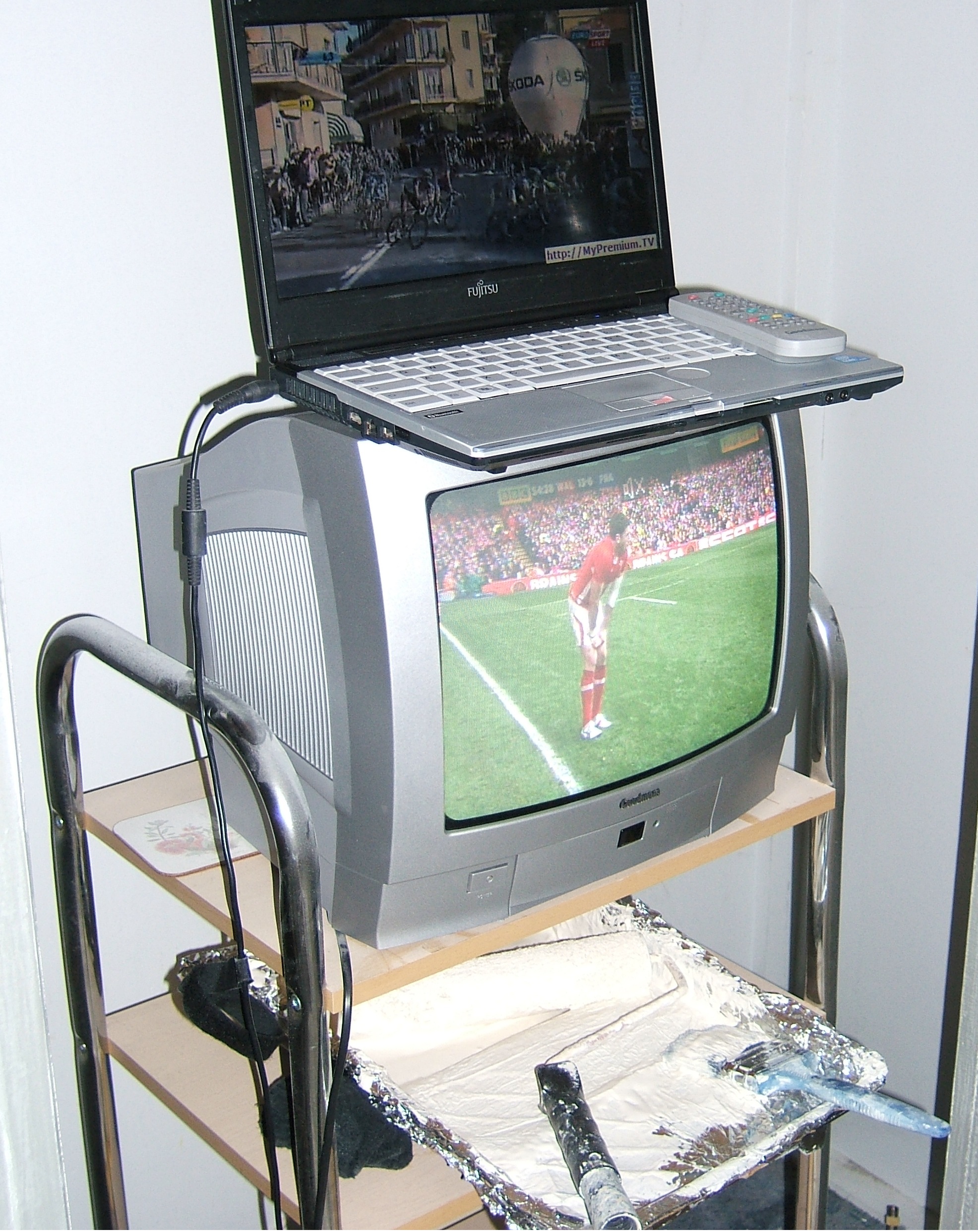
But how to cope with the clashes. My other sport is rugby. Clashing with the cycle race it was Wales-France with Wales going for the Grand Slam. And worse – I have only two weeks to finish decorating my son’s room before he gets back from uni, and I have been off travelling most weekends.

This is the sort of situation that brings out the creative sports fan.

Well organised

Well organised

Cycling on the laptop. Rugby on the TV. Paints in the hand.

Sorted.

NB – Wales win the Slam, England thrashed Ireland on St Patrick’s Day and it was a great finish to MSR, even if the whole bunch did ride against Cav.

Falling off

I take a certain pride in posting this clip from the British Universities Mountain Bike champs last year which has just been sent to me. To get the full effect tilt your head to the right, then you will realise the real angle of the hill by the way the spectators are standing.

http://vimeo.com/21034147 

About 2min 30sec into the clip the man rolling down the hill is my son, on his way to collecting a broken wrist for his pains. I must say I’m quite impressed by the roll, he must have been going for it at the time. What makes it worse is that he was also the one falling off at 1.14. Doh!

Apparently the organisers were using a regular course for downhillers and set out a cross country course around it, including some sections from the downhill. As the student champs is as much a beer weekend as it is a race a lot of roadies and casual riders entered to support their mates in the main race, but they were totally out of their depth on this section and the chaos ensued. I gather the roadies were really angry.

This set me thinking about the relationship between cyclists and falling off. Look at the crowd in the clip – mostly laughing, and certainly gathered at that spot for the falls. Read the comments below the clip on Vimeo.  Mountain biking web sites and magazines love a good crash. However mag pages featuring horrible injuries have largely been succeeded by on line video, mixed in with the spectacular leaps and descents are always a good selection of big “offs”. Every one watching this hill will know the feeling, falling off is as natural to mountain bikers as getting on the bike, certainly if you are going to stretch your abilities at any point. Of course the top riders have a level of skill which means that they can ride things I can’t even walk down, but they mostly had their share of falls on the way to that level. On the road and track it is almost impossible to have an extensive racing career without hitting the deck a few times, if not you take up pursuit and time trialling to stay away from other riders.

Compared to most downhillers I am a wuss. Like most lads I got my first wrist break in a bike crash when I was 11 years old. Martin Fuller (I can remember you wherever you are) switched me as we were thrashing our bikes down the road outside his house. Broken scaphoid bone (wrist again) on the concrete velodrome in Cardiff 20 years later.

Pretty near miss too at Aston Hill MTB centre when I almost broke my shoulder and got 10 stitches in a knee. Actually the sign at the top should have been a give away “Full body armour and full face helmet recommended”.

Most of the rest of my prangs were losses of skin and dignity, and today I seem to suffer a bit longer from the bruises, so I am a bit more careful. But there is something really special about knowing you were just a bit on the edge of your ability, something that I would only ever try on a bike, not in a car or plane.

People whose route into cycling was largely commuting or touring would regard us as totally mad. How can we get people cycling if they think it is dangerous? Didn’t the films of Jonny Hoogerland being clipped by a TV car in last year’s Tour de France and knocked into a barbed wire fence set cycling back years?

I don’t think so. If we are going to get a whole generation of teenage lads off their backsides and away from the video games for at least a few hours we are not going to do it promising a nice ride to school and eternal salvation. Try asking your teenage lad to go and dig out your potatoes because the organic food and the exercise will do him good. You’ll probably eat the shovel.

Now let him and his mates loose in a bit of old waste land with the same shovels and a few BMX bikes and tell them they can build what they like.

Good parenting says someone’s going to get hurt, bring on the health and safety police. Really good parenting says “don’t come home until dark, and call me from the hospital if you need a lift back”. Bring it on.

P.S. This post is not approved by my wife, who really could not see the funny side of Ben flying. It’s a Mum thing.