A visit to the War Memorials of Ypres and Tyne Cot – places of remembrance and reflection.

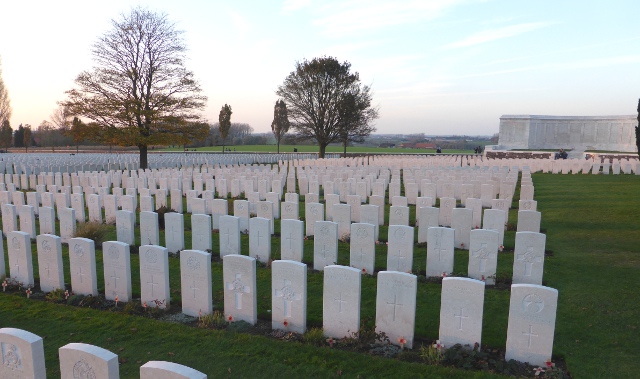
Tyne Cot Graveyard Flanders

Prompted by the arrival of Armistice Day in this 100th year since the start of World War 1 we visited the Flemish town of Ypres (Ieper), at the heart of commemoration of the war for many British and Commonwealth countries because of its position close to some of the bloodiest battles of that war.

This blog post has emerged in two parts. There is the tourist report of Ypres itself and one of the Commonwealth war cemeteries as part of my “Life in Belgium” series.

But this was a very moving experience and I was reflecting on why in particular this has such a different effect on us compared to other military history we see all over Europe, whether it be castles or ramparts or the Waterloo Battlefield close to where we live.

Ypres unveils itself slowly. Coming in to town it is a typical Flanders market town with its solid brick houses set into gently rolling West Flanders farm landscapes. It has the expected grand square with a gothic looking town hall and church spires.
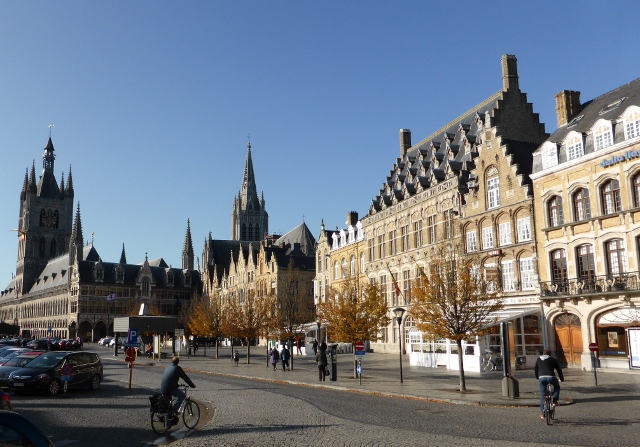
Photo Kevin Mayne Photo Kevin Mayne

There were many groups over from the UK and other countries but the town was not too busy on a chilly November morning.

However a visit to the “In Flanders’ Fields” museum in the town hall brings the whole scene into a sudden sharp perspective.  In the museum are the photographs of the town as it was in 1918 after it was the centre of no less than five major offensives of the First War. This left it ruined and deserted by civilians. Everything we could see on the streets around us has been reconstructed since then.

Copyright free from National archives

Winston Churchill, then Britain’s First Lord of the Admiralty, suggested at the end of the war that the whole town of Ypres should be left as a permanent memorial to the dead. But in a triumph of human resilience the residents of the town started moving back to their homes and farms the first winter after the end of the war and started rebuilding which meant that Winnie’s idea had to be scaled back to a memorial and the town’s major buildings were rebuilt to match their heritage.

Photo Kevin Mayne

There were great views from the bell tower of the town hall which showed the layout of the town’s old street pattern and way out across the Flemish countryside. Old juxtaposed with new in the form of windmills out in the industrial areas.

Photo Kevin Mayne

From this high vantage point there is also a clear view of the main centre of memorial for the city, the Menin Gate. The town had historic outer walls and the gate towards the Menin Road was where many troops left the town to travel to the front. So it was chosen as the site for the main memorial after the war. From a distance it is a relatively flat, plain structure built into the restored ramparts.

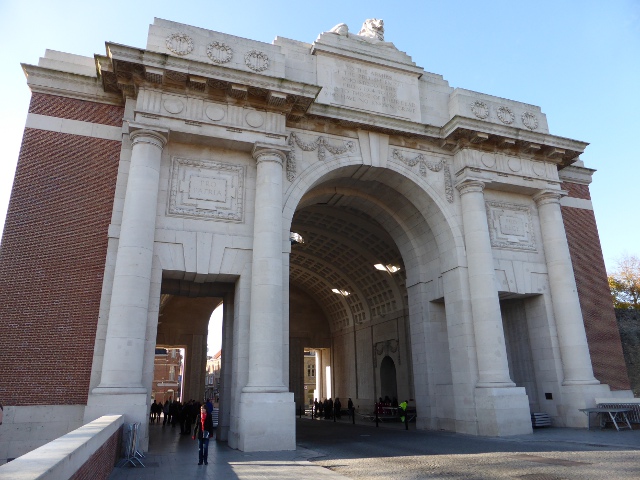
Photo Kevin Mayne

Photo Kevin Mayne

Only when passing under the arch into the main hall does the impact of the arch take shape.Photo Kevin Mayne

On it are carved the names of nearly 55,000 men whose bodies were never found.

Photo Kevin Mayne

The impression of the main hall was impactful enough but then we realised the names carry on through side arches and up onto a second set of balconies that run around the outside of the arch. Photo Kevin Mayne

Then up on the ramparts there was a field of memorial poppies which had been left by visitors. Written on each was a personal message, many of them to lost relatives.

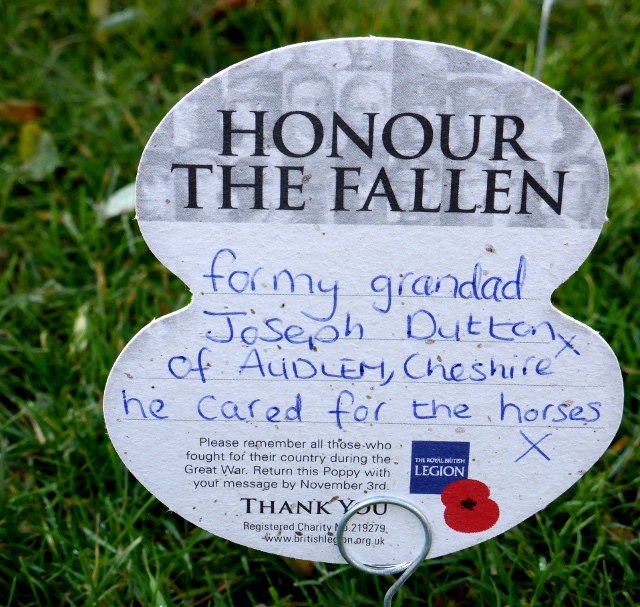
Photo Kevin Mayne


Photo Kevin Mayne

By the time we got to that point we were feeling overwhelmed and extremely subdued. For me I think it was the way the names were listed regiment and country. This means you can really see just how many men were missing from one area. For me it was the Norfolk and Suffolk regiments that I looked for but it could equally have been Surrey, Lancashire, Yorkshire, Australian states or Canadian provinces.
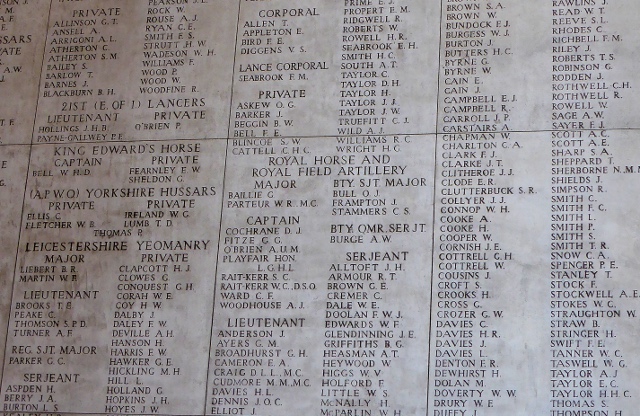
Photo Kevin Mayne

From Ypres we decided to head outside the town to visit the largest of the actual war graves in the area at Tyne Cot, a low hill about 10km from Ypres, close to one of the other most evocative names of the period – Passendale.

Photo Kevin Mayne

Tyne Cot is the largest Commonwealth war grave and is particularly significant for Australians and New Zealanders. The cemetery was originally created for a few hundred graves in an area captured by Australian and New Zealand troops in 1917. After Armistice in 1918 many other graves were consolidated there, with nearly 12,000 now on the site. Of these almost two thirds are unknown, identified only by their country and the words “Known unto God”.

Photo Kevin Mayne

As if that were not enough Tyne Cot is the memorial for the missing names that could not be incorporated in the Menin Gate memorial due to lack of space and because the New Zealand memorial is here. From the cutoff date of 15th August 2017 at Menin Gate to Armistice Day a further 34,000 men died without their bodies being found, an incredible number.

Photo Kevin Mayne

We were there in the late afternoon as the sun began to set over this most poignant of locations bringing a sharp highlight to the shapes of the graves. The spires of Ypres were just visible on the horizon.

Photo Kevin Mayne

We drifted home in quiet reflection. But in the following days I was still mulling over what we had seen. As I said at the start of the blog nobody with an interest in European history can miss the military history that surrounds us. Belgium is a really special case, the anniversaries of WW1 and the Battle of Waterloo made it one of Lonely Planet’s best in Travel 2014.

But within this setting the First World War memorials and commemorations just seem to be different. It seems that the huge loss of life in the fixed trenches with only small gains on either side somehow established the “the pointlessness of war” as a concept, especially as this war could be attributed by many to an imperial game rather than a war of liberty or values. The emergence of the War Poets and other writers who were not afraid to tell the story of the horrors tells us that values were changing.

And from these different attitudes to war came a different attitude to the dead, lost because of the failings of the leaders and the murderous nature of the new weapons of 20th Century warfare. In individual 19th century battles the numbers of dead were enormous – 65,000 killed in one day at Waterloo alone. But after WW1 we put up war memorials in every town naming the men who died individually and at Ypres there are no statues of generals, the memorials carry the names of every man, there is a grave for every un-named soldier. And like the war memorials at home they have a location through their regiments which in those days were locally based.

I didn’t have any relatives that I know of in the First World War dead, our histories haven’t turned up the family stories that we saw on the poppies in Ypres. So which entries at the Menin Gate left me blinking back tears?
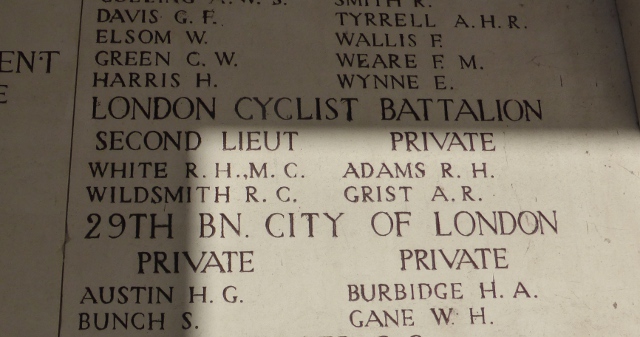
Photo Kevin Mayne Photo Kevin Mayne

The Army Cyclist Corps, the London Cycling Battalion. Two of the smallest entries on the memorial. There were cycling regiments in various forms in most of the armies with the British having 14 regiments by the start of the war. They didn’t see much service at the front because they were valued as couriers and support troops, but clearly they were close enough for many to be killed and lost around Ypres. Belgian cycling troops were represented in the photographs in the Museum.
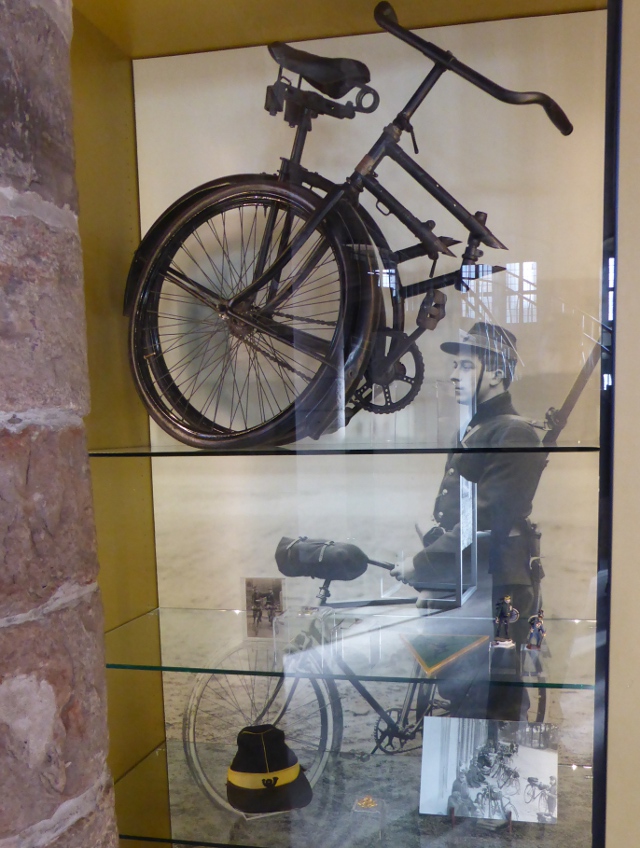
Photo Kevin Mayne Photo Kevin Mayne

Of course it’s personal because they were identified as cyclists. But it goes deeper than that. I know the role that the Cyclists’ Touring Club played in recruitment of these soldiers throughout the war, encouraging active cyclists “to do their duty”. One of my private hobbies while I was CEO of CTC was to wander to our archives and seek out historical references in our 130 year old library of CTC magazines and I have read many of those articles that were actually written by my predecessors. Whenever I could I went to the annual service at the Cyclists’ War Memorial at Meriden, a very special place in the history of cyclists at war. When it was unveiled in 1921 over 20,000 cyclists came to the service.
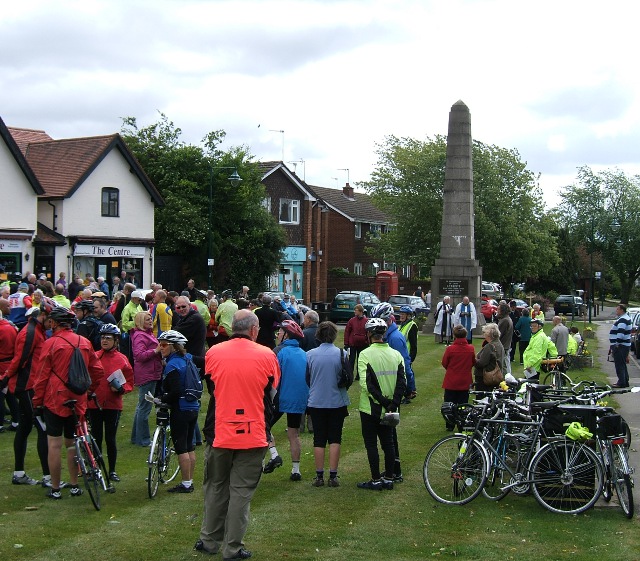
Photo Kevin Mayne

But having been exposed to that history I just could not walk away from those memorials at Ypres without thinking “what would I have done?” As someone who recoils from modern warfare I feel deeply uncomfortable about militarism and wars as a symbol of nationalism. It is challenging enough to wonder whether I would have fought at that time in that culture. But to have played a role in sending people from our club into the war is unimaginable. It hit me with force that day in Ypres as I saw the names of those missing men and it still plays on my mind as I write this.

The battlefields and memorials of Flanders are an interesting and thought provoking visit. I am sure we will return, as will the questions.

For more on cyclists and CTC in WW1 there are some links here, here and here.

There is a very good podcast to download here

The mind is willing, but the flesh is weak – summary of today’s bike ride. Good job it was a lovely day!

In my mind’s eye I jumped out of bed this morning to knock a quick three hours of enthusiastic riding and to test a replacement winter bike.

Completely separately my body announced that it was willing to tolerate 2-3 hours of gentle touring but foolish notions of energetic prancing about were not going to be tolerated.

This message was delivered about 200 metres from our gate when I hit the first short stretch of cobbles that marks the edge of the village.

Photo Kevin Mayne

It is a good job it was a lovely day. Stunning views from the Chapelle du Try-au-chêne above the valley of the Dyle at Bouseval. And the bike rode well.

So never a day wasted.

A brief visit to Sofia, capital city of Bulgaria

Mount Vitosha Sofia Bulgaria

Having written about cycling in Sofia in my previous post this one is about my impressions of Sofia as a tourist in the two brief tours that I took around the city centre in my short visit.

It was very much late autumn here with the first cold temperatures of the year coming in, down to about four degrees centigrade overnight and there was snow on the Vitosha Mountain that overlooks the city. The city was mostly wrapped in a steely grey grip that briefly lightened for our afternoon bike tour but otherwise kept things a bit dull so maybe we didn’t see the city at its best. But I must say the mountain itself is a great landmark as you move about, forever on the skyline and real symbol of the city. I really wish I had enough time to take a trip up there, it looked amazing for walking or mountain biking but it would be a substantial excursion of a few hours.

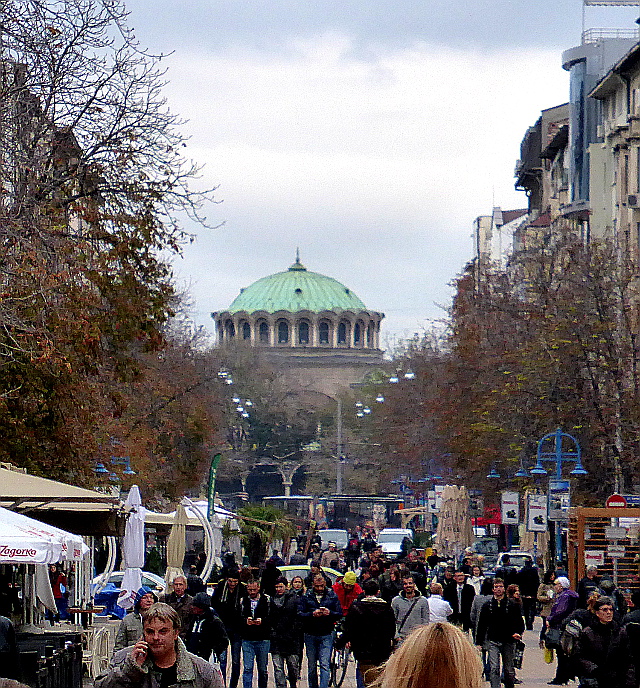
It would probably be fair to say that Sofia is not one of Europe’s tourism hot spots. Nor one its wealthiest cities, so it has a slightly run down feel with buildings, roads and parks often in need of some repair and restoration. What it has in its favour is a rather sleepy, quiet nature because for a capital city of well over a million people we did spend some time wondering where they were. Little of it is completely car fee except the main shopping drag of Vitosha Boulevard but the main city centre buildings and parks are mainly in two central neighbourhoods which were easily accessible by bike, foot and metro so it was actually a really easy city to navigate.

Photo Kevin Mayne

What Sofia also has is an incredible history. Its pre-Roman history goes back to 4BC, then it was a major Roman centre for nearly 500 years. At times it was part of various Bulgarian empires which brought a Christian heritage but for another 400 years it was part of the Ottoman Empire. In the 19th and 20th Centuries it fell into the Russian sphere of influence with a communist government from 1946-1990. Unfortunately it was flattened and rebuilt several times in that process so much of ancient Sofia is buried under the later layers and it is a bit of a detective exercise to see the differing elements.

What we mainly saw to represent the city history were two distinct groups of buildings.

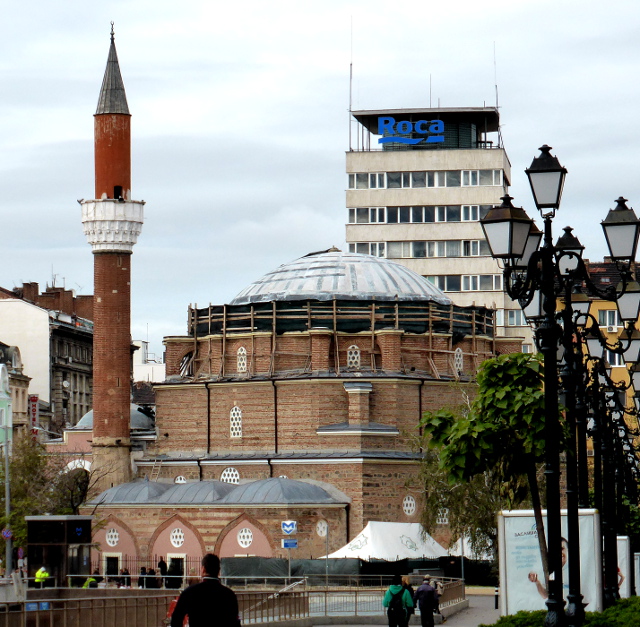
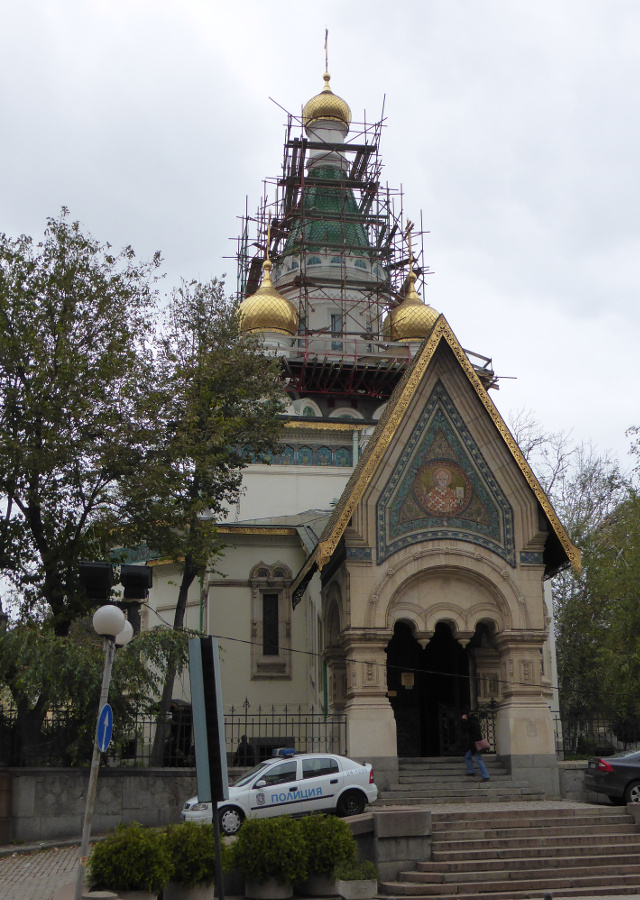
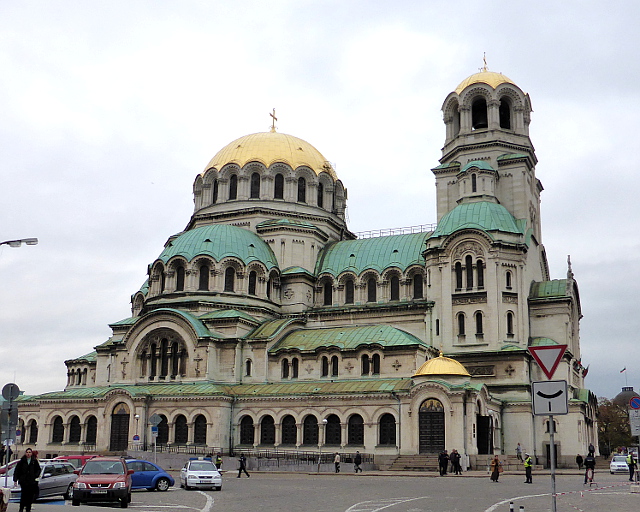
The first were the religious sights – cathedrals, churches, mosque and synagogue reflecting the diverse heritage of the city.

Photo Kevin Mayne Photo Kevin Mayne

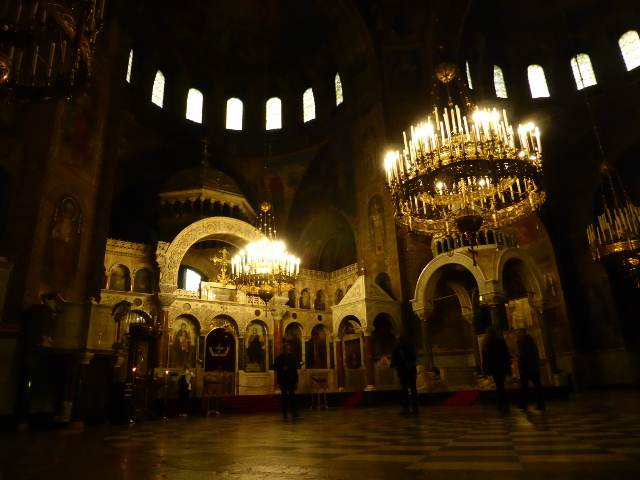
Chief of these was the Alexander Nevsky Cathedral which turned out to be quite a surprise for me. From the outside it is a giant of white and gilded domes.

Photo Kevin Mayne

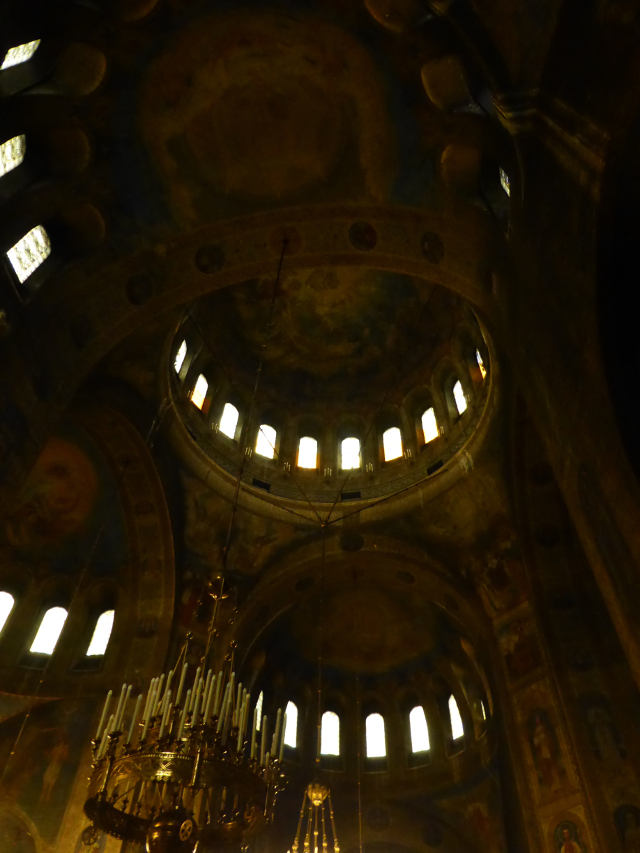
But inside it was dark and unlit except for tiny windows up in the dome and large groups of candles. One could sense the detailed painting on the walls and up in the heights the dome could be brightly decorated but it was the darkest, gloomiest major cathedral I have ever been in, almost cave-like.

Photo Kevin Mayne Photo Kevin Mayne

By complete contrast the tiny Saint Petka Church was a medieval church sunk below the level of the city roads close to excavations of the old city which are being unearthed in front of a new metro station, one of the few surface signs of an older Sofia.

Photo Kevin Mayne

The second group of buildings reflect the more recent Soviet past. Almost inevitably there is a huge block of Soviet architecture of which the most striking was the former Communist Party Building, the Largo building which is a classic of its type.

Photo Kevin Mayne

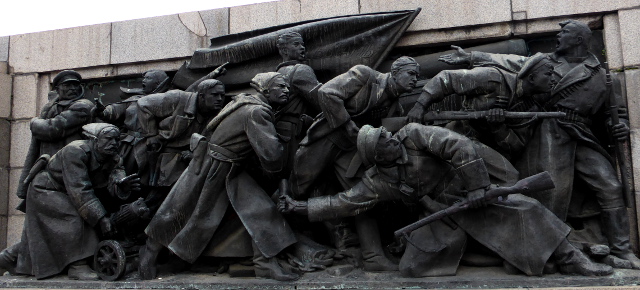
The memorial to the Soviet Soldiers also survived the end of the communist period in a small park to the west of the city centre with its dramatic statues and friezes.

Photo Kevin Mayne Photo Kevin Mayne

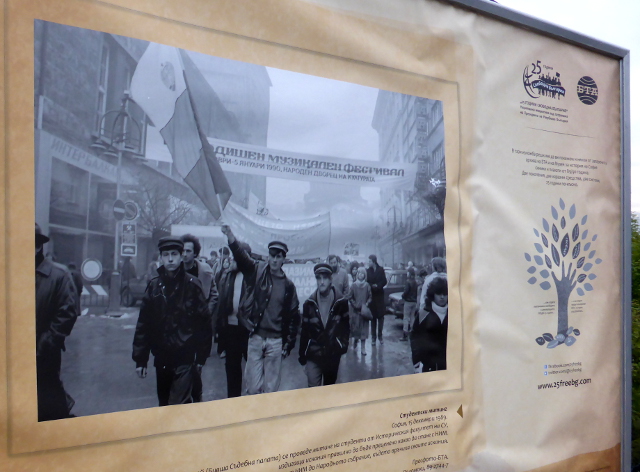
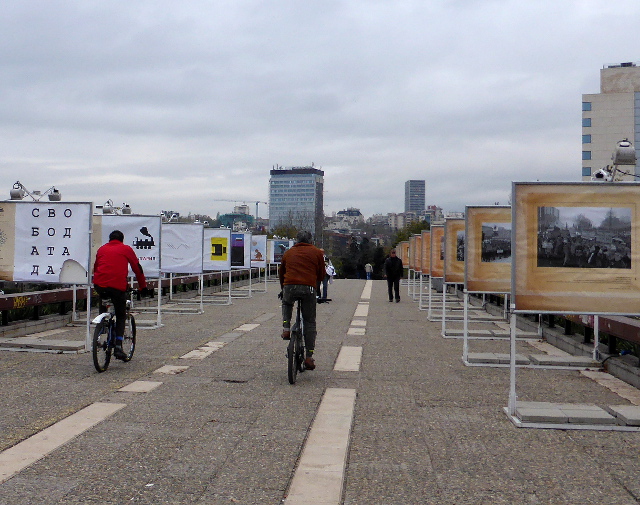
The complete contrast to the features that represented the communist period was a display near the National Cultural Centre which celebrated 25 years since the end of communism. There were evocative photographs and logos from the period right across the bridge, although I couldn’t help but be amused by its proximity to the drive-through McDonalds – was this what the revolution was for?

Photo Kevin Mayne Photo by Kevin Mayne Exhibition poster of 25th Anniversary of fall of Communism Sofia Bulgaria

Other highlights were the National Theatre and the attractive gardens out front.

Photo Kevin Mayne Photo Kevin Mayne

In addition to the physical sights of Sofia I have to say that everyone we met was incredibly helpful and welcoming, from our hosts to hotel staff, restaurants and cafe staff. They went out of their way to make us welcome at the Bulgarian themed restaurant – traditional dancing a bonus!

Photo Kevin Mayne

And a thank you to the bar staff on Vitosha who said they were closing, and then kept the doors open as long as we were there. I guess that is the advantage of being the only customers in town!

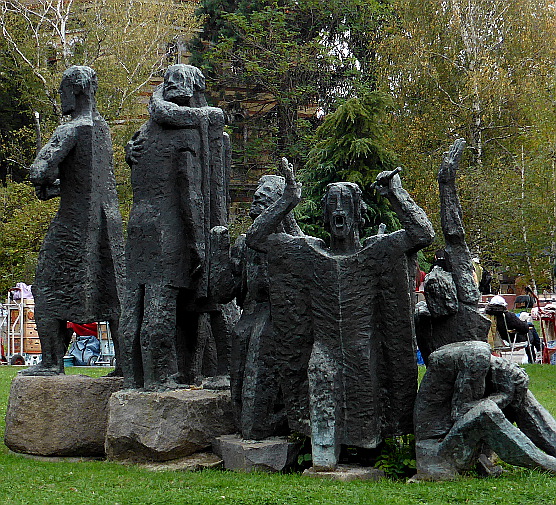
I leave the post with pictures of some striking statues in a square just in front of the Alexander Nevsky Cathedral. My research has failed to turn up their subject but I found them quite moving.

Photo Kevin Mayne Photo Kevin Mayne

Cycling in Sofia, Bulgaria – positive observations from a short visit

Time for another “Idonotdespair” moment, trying to get a snapshot of the cycling culture in a new city through the eyes of local activists, a short ride and some general wandering about. I was in Sofia, capital city of Bulgaria for three days this week which included a guided cycle tour of the city centre and a similar walking excursion. I have broken my usual collection of photos and comments into two posts, this one about the cycling experience and then a few tourist notes in a few days’ time.

I think the cycling can certainly be summarized as “far better than expected” because the country hovers towards the bottom of most European cycling league tables and expectations had been set fairly low by our hosts. But I found a lot of positives and yes it was so much better moving about by bike than walking!

We were in Bulgaria with delegates from small and medium sized cycling organizations as part of a programme to support European groups that are trying to make the jump from smaller, informal structures to try and create a national impact. So I wasn’t there on my own and that helped keep the differences in perspective. Coming to Sofia from the low cycling countries like UK, Greece, Ireland, Czech Republic and Ukraine it really didn’t feel vastly different to home, so we of course were able to share our experiences as “kindred spirits”. On the other hand at least one person in the mid rank of cycling nations who joined us (Austria, Finland, and Sweden) said she certainly felt a bit better about her home city after cycling here.Photo by Kevin Mayne

First impressions were not great. In the taxi from the airport we were faced by nose-to-tail traffic queues and wide high speed boulevards that made me suspect that this was another east European city that had embraced the car with enthusiasm in the last 25 years. It was not until we reached our city centre hotel that I was delighted to notice a cyclist, inevitably a hipster on a fixie jumping a red light. There must be a factory somewhere in Taiwan that just creates them and sends the whole unit over to Europe as one item, person, bike, trendy beard and colour-blindness included.

Photo by Kevin Mayne

The start of our group bike tour the next day confirmed some of the poor impressions. We were cycling on multi-lane roads or encouraged to share the lumpy, poorly repaired pavements with pedestrians, neither of which was particularly appealing. The infrastructure gave no help knowing which route or what positioning on the road to take. Our guide did point out a few places where there were once cycle lanes and the paint had worn away and suggested the city really didn’t know what to do with cyclists now. I was very grateful that we did have a host to start with, it gave confidence that we were actually riding in an accepted manner. (Although more of that below)

Photo by Kevin Mayne

Throughout the trip I noticed that the city had the parking plague, every street, spare corner and open space seemed to be covered with parked cars and they were often double parked, pushing us out into the traffic. In that it reminded me of Kiev, Ukraine, because there was potentially a lot of space for cycling facilities but no space to install them without taking on the parking menace.

Photo by Kevin Mayne

Nice cobbled streets around the National Theatre offered the possibility of an attractive slow moving network of cycle friendly streets like I had seen in Madrid in September, but the parking was still intrusive and not well controlled. The road surfaces were pretty awful too but after three years of Belgium I hardly take that into account any more, I rather regard it as a form of traffic calming.

Photo by Kevin Mayne

Towards the end of our tour we turned back towards our hotel along Vitosha Boulevard, the main shopping street of the city that gets its name from the dramatic snow covered Vitosha Mountain that is visible on the skyline right along the street.

Photo by Kevin Mayne

By the time we did so I was in a thoroughly good mood from the cycling and beginning to quiz my colleagues about what I had seen and felt on the ride. Because I certainly wasn’t getting the impression that this was a frightening, anti-cycling city. That impression was reinforced the next day when some of us walked around other areas.

Most importantly of all I felt that the drivers of Sofia were some of the most patient and well behaved I have come across. Seriously! It seemed common to just to wander out into the street and face down the cars which proves to me that is far from a car dominated city centre. At no point was our large group honked at and passing distances were well respected. Whenever a pedestrian or another cyclist just wandered out into the carriageway or attempted a pedestrian crossing the motorists stopped almost instantly so we started doing it too.

Photo by Kevin Mayne

Turning at junctions the traffic didn’t race off, people were able to cross and in the small streets traffic speed was very sensible, especially in the numerous 30kmph speed limit zones.

The other thing that struck me was that the numbers of pedestrians and cars was incredibly quiet for the centre of a large European capital on a weekday. I kept thinking I must be missing something such as a public holiday, but apparently not. There were definitely traffic jams out on the peripheral roads and arterial corridors but it really was quiet and sedate to get around by bike in the city centre. I wonder if it is the traffic management that makes everybody so patient, the waits at traffic lights were never ending? However in most cities where cars queue at traffic lights it seems to make them impatient and grumpy, here I just didn’t get that impression. It may be that we were the beneficiaries of a significant police presence, especially at larger junctions where they still have these brilliant little control boxes that sit up above the street corner and manually intervene to control the traffic flows. How old school is that – brilliant!

Photo by Kevin Mayne

When we walked a bit beyond the city centre we came to some of the many parks that run around central Sofia.

Photo by Kevin Mayne

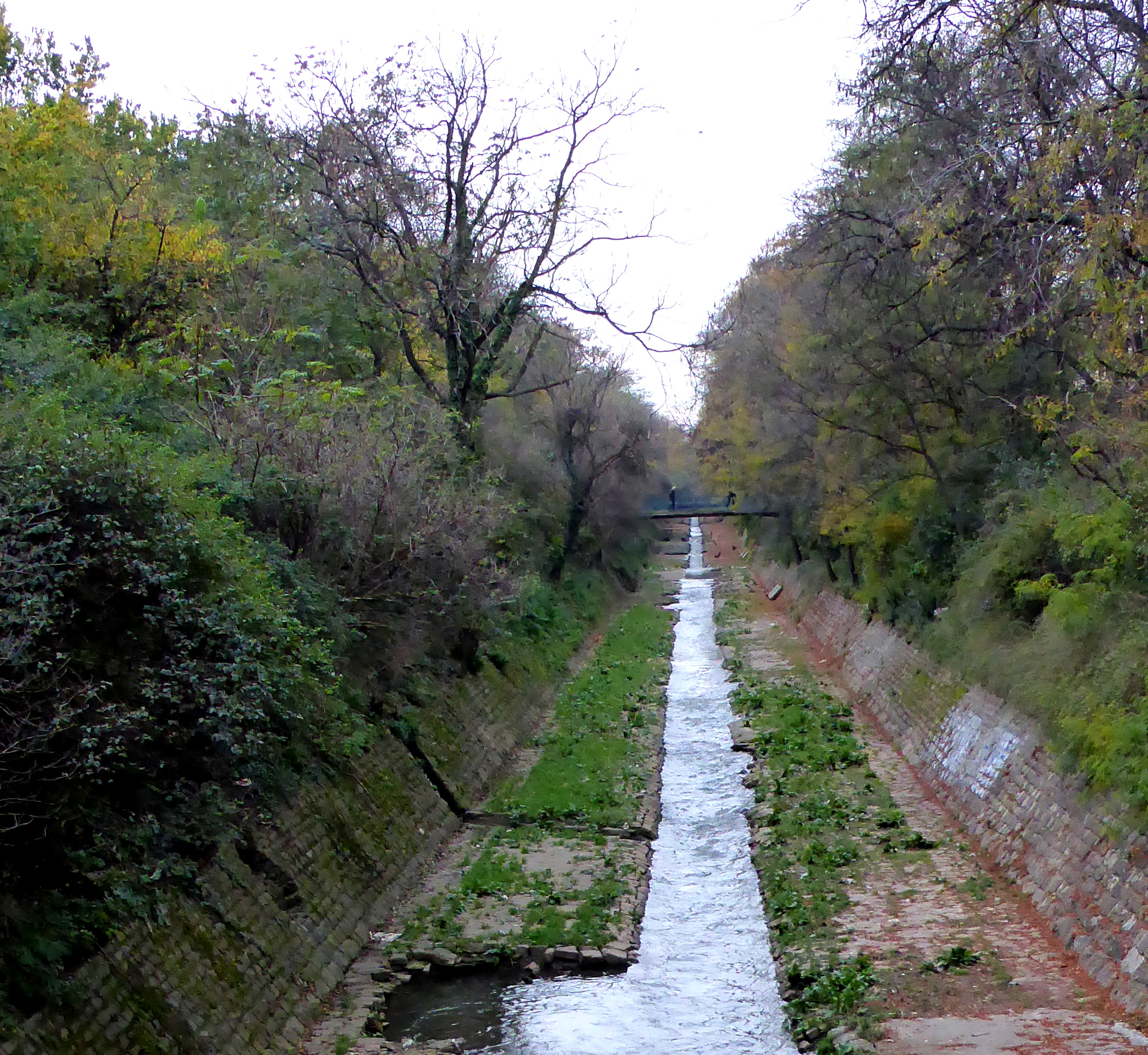
Here there were networks of quiet car free paths and alongside the canalized Perlovska river there were long cycle lanes looping around the south of the city centre. They too were not in wonderful condition, but they were there, and being used.

Photo by Kevin Mayne

Photo by Kevin Mayne

The last discovery of the trip turned out to be just near our hotel where we found a large, wide cycling and walking bridge linking the National Cultural Centre to the southern suburbs, allowing people to cross a really nasty main road into the city centre from their residential areas.

Photo by Kevin Mayne Photo by Kevin Mayne

This is the kind of infrastructure we desperately need to fill missing links in our networks in so many cities and here was a perfect example in a place that is supposedly really bad at infrastructure. How confusing.
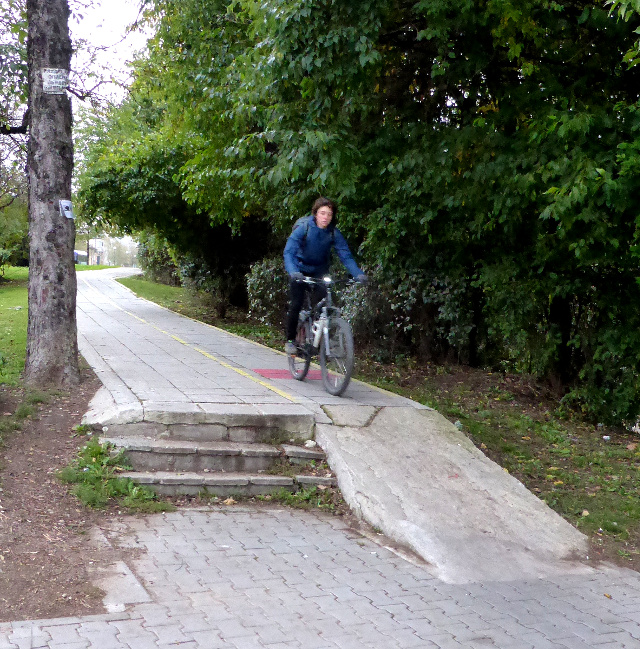
It was a bit spoiled by the nasty collapsed drain cover on the down slope but most of the locals seemed to know it was there, the BMX riders jumped it and the oldsters went round.

Photo by Kevin Mayne

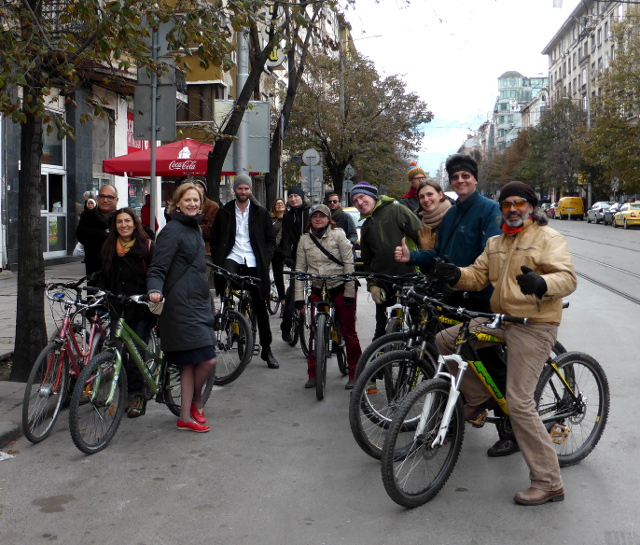
Because there were cyclists. Not in huge numbers but almost everywhere we went in the city there were just ones and twos pottering about on the streets and pavements. No it wasn’t a lot and I could see that they probably didn’t add up to more than the 1% mode share claimed in the published statistics. But they were there and it wasn’t just the cool dudes. We saw older people, mothers with children on child seats and younger women which also suggests that the environment was not totally hostile to all but the fearless.

What surprised some colleagues more was the bikes. They were 90% cheap mountain bikes, only occasionally did we see a more equipped city bike. Again those of us from low cycling countries were less surprised, a population that doesn’t cycle much and therefore doesn’t understand the need to pay more for mudguards, a rack and some city tyres is just what we experience all the time. We did conclude that fat tyres and suspension was probably a good idea when a lot of Sofia cycling seemed to involve bouncing up and down kerbs but we know that you have to build up the population’s knowledge quite a bit more before the better equipped bikes become more common.

Photo by Kevin Mayne

So I leave Bulgaria slightly puzzled by my cycling experiences in Sofia. In many ways this was like my experience of Berlin with its wide streets, quiet traffic and well enforced traffic laws. And in that context cycling could and should flourish because the traffic jams on the arterial roads were bad and there is only a two line metro service to fall back on.

I guess cycling really hasn’t set down new cultural roots in the city and it is going to take a slow steady campaign of promotion and a lot more commitment to cycling infrastructure before it takes off, if only to help people know where and how to ride.

Photo by Kevin Mayne

What this place needs more than anything else is more cyclists because a visible group on the streets riding around safely will do more than anything else to show what is possible.

Probably I got an artificial impression in the centre because the traffic did look more aggressive further out. But there was a huge maze of minor streets around the suburban apartment blocks which could be bike friendly. Of course what usually fails in those circumstances is crossing the big roads and I may be wildly over optimistic from what I saw, any bike route is only as good as its most challenging junction because that is the one people won’t cross. But I couldn’t help but feel the city centre is a good destination for cycling, there must be something to build on there and I would certainly ride there on my own on a return visit.

Now we will do what we can to help our passionate friends at the Bulgarian Cycling Association and their allies to take advantage of what they have because it will be a long road to build up a cycling culture from such low numbers.

Photo by Kevin Mayne

But it is possible that their underlying conditions are a lot more tolerant than in many other countries.

I do not despair.

El Botroul – glorious Autumn mountain biking in Belgium

Gallery

This gallery contains 15 photos.

Last Sunday I got up early and rode off into a misty Autumnal sunrise to take part in El Botroul, my club’s big annual mountain bike randonnee. The day was glorious and there was a lovely early autumn feel to … Continue reading

How did your Sunday start? Beautiful Autumn mists over Wallonia for me

Stunning views over the Brabant Wallon valleys at the start of my Sunday ride.Photo Kevin Mayne

Lunch with attitude. Is this the ugliest meal in Madrid?

Arrived in Madrid today to speak at the Unibike cycling trade show at the weekend.

The presentation of lunch was initially very off-putting – but in the end very tasty.

Who had the idea that fish simulating crocodile eating itself made the food more interesting? A high risk strategy indeed.

Photo Kevin Mayne


Photo Kevin Mayne

Nice setting though.

Plaza del Ildefonso Madrid


Flanders cycle tour day 3 – Bicycle Paradise.  Geleen, Maasmechelen, Hoge Kempen National Park, Genk and Hassalt.

Gallery

This gallery contains 17 photos.

I keep wanting to write that that this trip was a “Tour of Flanders”. However the cycling traditionalist part of my brain keeps telling me that the name Tour of Flanders is reserved for Ronde Van Vlaanderen the great one … Continue reading

Day 2 of our Round Flanders Cycle Tour: “A tale of two Limburgs – Belgian and Dutch” From St Truiden to Tongeren then across the border to Maastricht and Geleen.

Gallery

This gallery contains 21 photos.

Today’s route was multinational. We started aiming to cycle round Flanders but it was impossible to cycle past the famous Dutch city of Maastricht without paying a visit and after that some minor navigation errors saw us spend the afternoon … Continue reading

“It’s the end of the world as we know it. (And I feel fine.)” A special last ride in New Zealand. Thanks to everyone that made the cycling on this trip possible.

Bluff Point sign

So this was the final day of my six weeks in Australia and New Zealand. It has taken me almost that long again to write it all up, but the last day’s ride was so good it feels vivid and fresh right now.

It was not only a symbolic end, I physically reached the end of New Zealand’s South Island, spending my last morning riding on Bluff Hill, a rocky dome of a hill that rises 265 m (870ft) straight from sea level at the very southern tip of New Zealand’s South Island. It has 360 degree panoramic views along the coast, inland towards Invercargill and even to the mountains far beyond. The Maori name for the hill is Motupõhue which means “island of põhue flowers”, because from the sea it appeared to be an island rising before the rest of the land could be seen. Despite its remote location Bluff has a claim to be the longest permanently settled European town in New Zealand, the first trader and farmer bought land off the Maori here in 1824. Today it is still an active port although many Kiwis will be much more interested in the seasonal Bluff Oysters, considered the finest of delicacies and craved by exiles.

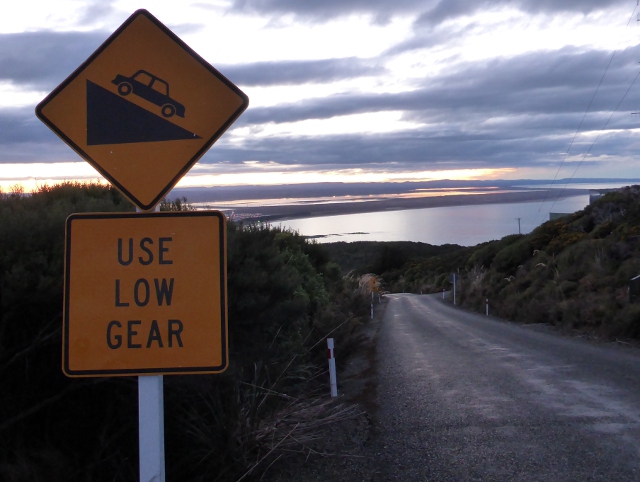
I knew about Bluff Hill from my previous trips to Invercargill. Everywhere has a hill like this. The one you have to go and try when you think you have become a cyclist. The local cyclists talk about it in that tone that tells you it is a place of legend. When you are even part way up your legs are burning and you are frantically looking for a lower gear that you don’t have any more. Bluff Hill’s reputation is enhanced because the Tour of Southland, New Zealand’s toughest bike stage race regularly finishes at the top.
Flagstaff Road Bluff New Zealand

However I had never actually cycled there on my previous trips, mainly because it is 25 km south of Invercargill and the access is an open stretch of main road that I had never fancied riding. However this time I was updating my knowledge about what was going on locally when I saw a link to Bluff Hill trails on the Southland MTB Club web site.
Within moments I knew that this was a “must do”. A bucket list item almost. To know I had ridden on what is possibly the most southerly set of planned and maintained mountain bike trails in the world? To ride up above the countryside and sea and take in the landscape at this unique place. To know I could spend an hour or more playing on good mountain bike trails rather than just head-banging down a main road. You bet I was going to try and go there.

I hadn’t really planned on it being the last day but that is the way that time escapes on a short visit. So to maximise family time and get in my special ride I compromised and got up at 6am to drive my in-laws’ car out to the foot of the hill, ready to ride at first light.

Bluff Hill Flagstaff Road in the dark New ZealandThat part of the plan went perfectly. Too perfectly. I arrived just as there was a glimmer of dawn on the far horizon, but I couldn’t actually see a yard in front of my face at the trailhead so any prospect of riding up the hill off-road had to wait.

Instead I took the route of most pain and climbed the almost straight road to the top of the hill. It is 22% at the steepest point and an average of 11% so I certainly needed the mountain bike gears, doing that without any sort of warm up at 7.30 am in the morning would have had me walking for sure on a road bike.

But then my timing turned out to be absolutely perfect. As the light crept in under the clouds the landscape changed magically, second by second. Each time I lifted my head deep blues turned to pinkish hues behind me and the road surface became more visible.

Bluff Hill view New Zealand

Buff Hill sunrise New Zealand

Dawn from Bluff Hill mountain bike tracks New Zealand

As I got to the top a soft yellow glow was driving away the shadows right across the landscape.

Bluff Hill Sunrise over south coast of New Zealand

Way in the north Invercargill was visible a series of light spots on the flat plain.

Lights at dawn Invercargill from Bluff Hill New Zealand

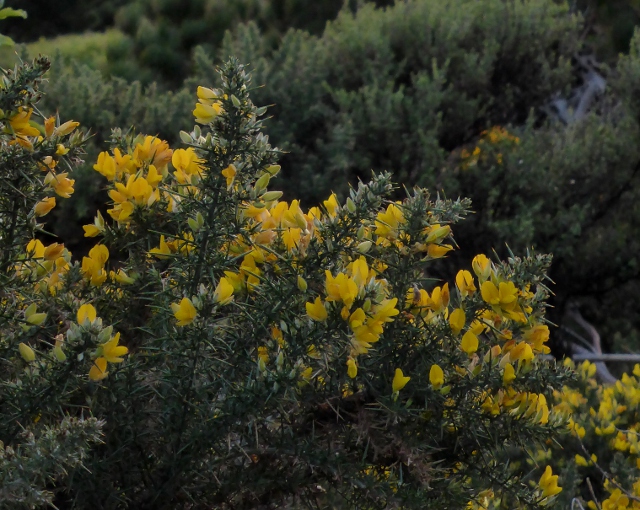
I was also blessed by the weather. The start of winter and I was wearing a light cycling top and shorts in almost windless conditions, an incredible stroke of luck for the views and the riding. Despite it being winter clumps of hardy gorse were in bloom, the yellow flowers seemingly sucking up the rays and glowing against the grey-green backdrop.

Gorse flowers on Bluff Hill New Zealand

I don’t know how long I hung around at the top taking in the rising sun and the changing views but I had to pinch myself to remember I was there to ride as well.

Bluff Hill viewing point at dawn

I looked momentarily at the entrance point to the “Downhill route” which descends a terrifying straight line and is graded “Black” or “expert”, but knowing that it was not for me I dropped down the shallower side of the hill and played for an hour on the intermediate trail network. It weaved its way up, down and around the hillside, offering me a good variety of riding. But what made this set of trails special today was that every corner offered a different sea view, and when I was sure I had gone round a section more than once it didn’t really matter because the effect of the sunrise was to make it feel subtly different each time.

Bluff Hill Mountain Bike Trails New Zealand Bluff Hill Mountain bike tracks New Zealand Bluff Hill Mountain bike track with sea view New Zealand

All the time in my head I was revelling in where I actually was, at the far end of the world and at the end of my holiday. Throughout the ride a song played in on permanent repeat in my head. REM’s “It’s the end of the world as we know it” was the song of the day. Inevitably? Maybe, in the odd way my mind works.

Then time was up and I let the bike flow its way down the lumps and bumps in the track to the parking where mine was still the only car, another joy of riding on a winter dawn. It was indeed the end of the trip, and fate intervened to tell me so in no uncertain terms. As I freewheeled into the car park there was a horrible rending noise, all pedalling ceased and I looked down to discover a very distressed gear mechanism in quite the wrong position. My last seconds, my last ride and my only mechanical failure of the whole trip.

Time to go home, but what a way to finish.

My huge thanks to everyone who made the cycling on this trip possible. The mountain bike trail builders of New Zealand and the local authorities building bike paths all over Australia and New Zealand. The friends, family and commercial companies that made it possible to beg, borrow and hire eight different bikes in six weeks. Jason I am really sorry about the last day mishap on your nice mountain bike – I hope you have it fixed now.

Last and by no means least the family, friends and hosts who indulged me once again while I went off at all times of the day to get my cycling fix. I had come to see you all, of course, but a bit of pedalling made me a nicer human being – trust me. As my favourite travelling companion knows best of all.

If you cannot see a link to the REM song here in the email version of the post click “View in Browser” for a working link.

A morning’s cycling in Invercargill, New Zealand. Not despairing in the deep, deep South

After two days in Invercargill I was getting quite desperate for a bike ride. Then my first ride delivered a special day that brought back old memories and created some new ones, combining favourite Idonotdespair riding elements in to one package. At the extreme end of the developed world I found dawn riding, waterside cycling, exploration, stunning scenery, almost car free and some playtime. It may have been a bit grey and overcast, but what more is there in a cycling morning?

My big problem for the first two days wasn’t only that I needed my regular fix of pedalling, but because I was seeing so many people out riding in bright winter sunshine I was just plain jealous. That surprised me, from previous trips I know there is an active club cycling scene here but I had no recollection of regular leisure cycling on a day to day basis.Cycling Waihopai river path Invercargill

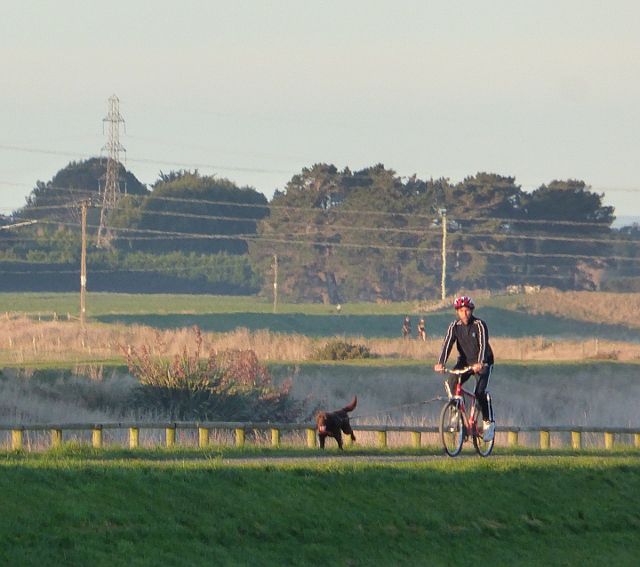
I was out for a walk each day when I found that the Waihopai riverside path near my in-laws’ house is now regular spot for many people having a late afternoon spin. This included lots of people out riding with their dogs which made me even more jealous, my furry riding companion was 12,000 miles away.

Bike ride with dog Invercargill Cycling with dog Invercargill

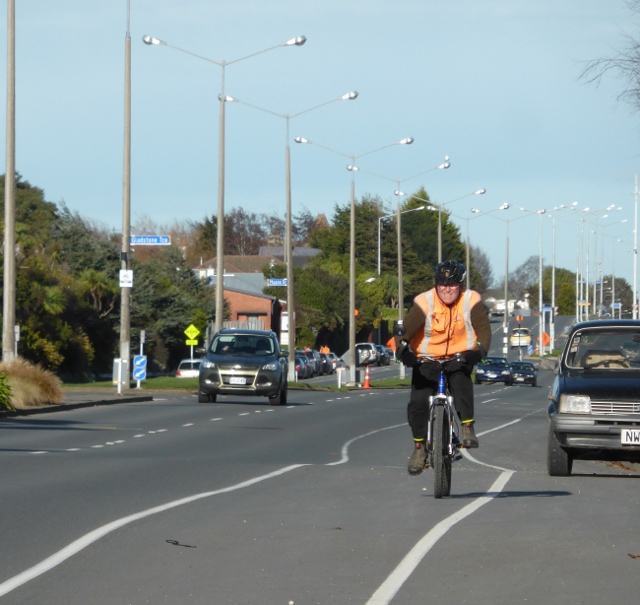
Complementing this nearly all the big wide roads seem to have gained a cycle lane and those were in use too. Enforced 50kmph speed limits and no cycling fatalities since 2008. Why wouldn’t you cycle? Even in winter. Good news indeed.

Cycling in Invercargill

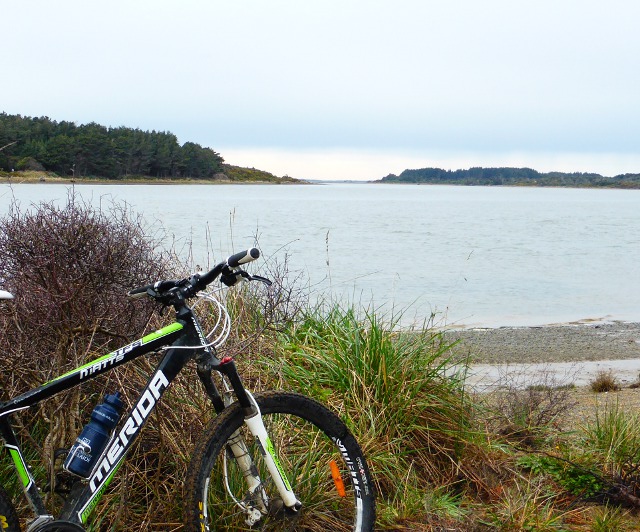
Fortunately I didn’t have to wait long to lay my hands on a bike. Invercargill being the close-knit community that it is the word was soon out and a nice guy called Jason loaned me his very tidy Merida mountain bike so I could sample the mountain bike tracks that were beckoning me.

Invercargill winter sunrise Winter rainbow over Invercargill

The first thing that delivered was the dawn sky with a lovely sunrise and rainbows. I then picked up the riverbank path which let me completely bypass all the city roads and took me quickly to the open banks of the estuary and spectacular views of the Southern Alps in the far, far distance.

New River Estuary Invercargill New Zealand Southern Alps from the Oreti River Invercargill

My destination was Sandy Point, a 5km long sandy headland across the mouth of the Waihopai and Oreti Rivers. It is a long, low lying area that was originally just sand dunes, forest and open heathland. Today it is Invercargill’s playground with about 20 sports fields and most importantly for me it has the Sandy Point Mountain Bike area, a fun section of twisty trails cut into the forest that were going to make my playground for the morning.

It was almost an hour’s ride each way to the MTB area but I loved every pedal stroke because I was treated to water views, wild birds and plenty of wide safe cycle lanes.

Oreti Cycle Way Invercargill

By contrast when I got into the woods for my mountain biking it was a dark maze of interconnected paths, up, down and around every lump, bump and hillock in the area. I know many of my readers are daily cyclists and cycle tourists who may wonder about the attraction of this stuff mountain bikers call “singletrack”.

Sandy Point Mountain Bike Area Invercargill

When I started mountain biking it was really just a sort of cycle touring but across hills and forest tracks instead of roads. Only when my skills improved did I learn to throw myself in and out of the trees slalom style, making me smile as the bike dips and roll with the terrain. Being low-lying and sandy this site didn’t offer the volunteers who built the trails an opportunity to do anything rocky or terrifying which suited me perfectly, this was “just for fun”. Once again my thanks to the local volunteers, this time Southland MTB club who have been working on trails on Sandy Point for over 20 years.

Sandy Point Trail map

I guess I played for about an hour without exhausting the trail network, but I was beginning to tire with the constant changes in direction and gradient. So I decided to finish my Sandy Point ride with the icing on the cake. This place is already unique because it is one of the most southerly mountain bike trails in the world. But it has another wonderful feature that makes it stand apart.

Oreti Beach sign Invercargill

Oreti Beach.

On the seaward side of Sandy Point is a spectacular open beach that runs for kilometre after kilometre around the huge bay between Invercargill and the coastal town of Riverton, some 40 kilometres away to the west. Out to sea is Stewart Island, New Zealand’s third island which makes a stunning backdrop to the beach and the waves of the Southern Ocean. I don’t know how I can give the sense of space that I get on Oreti Beach, winter or summer. I guess there is something in my head that tells me that this is no ordinary sea, there is almost nothing out there beyond Stewart Island but one of the greatest and most feared expanses of water on the planet, the wild Southern Ocean.

Oreti Beach in winter Invercargill

The fine sand is packed hard by the wind and tide which means not only is it beautifully flat but it is firm enough to take the weight of bicycles, motorcycles and indeed cars. It is an Invercargill institution to drive out in the summer for days on the beach but I have never seen it look busy because the area is just huge. In the middle of winter it was completely deserted, I had it entirely to myself. If I had the time I could have ridden for hours.

Some readers may also have seen Oreti Beach before. If you are a film fan you may recall a 2005 film called “The World’s Fastest Indian” where Anthony Hopkins played an eccentric Kiwi from Invercargill called Bert Munro who broke world records on his Indian Scout motorcycle. Oreti Beach plays a key role in the movie because it is here that Bert comes to test the speed of his bike and gets into a race with some local youths. Bert did test his bikes here and parts of the film were made locally.

Or, for my British readers who are also members of CTC, the cyclists’ charity. Open your copy of the CTC magazine this month to page 76, the members’ page. Down on the bottom right you will see a nice photo of a cyclist riding on a sunny beach that appears regularly on this page.

I’ll give you a better view of an original.from the same day.

Oreti Beach - Invercargill - New Zealand

My son, Ben, riding on Oreti Beach on our last trip in 2005. I gave the picture to the CTC editor to use some years ago, I am pleased he likes it too because he has thousands of pictures to choose from. I just wish more people knew the wonderful spot where the picture was taken.

On this trip it was just me, a bike and the memories, some old, some newly minted. What a great place to ride a bike. Not despairing in Invercargill.

Ruins and reconstruction – a moving visit to Christchurch – New Zealand’s earthquake city

Gallery

This gallery contains 17 photos.

Christchurch is the major city of the South Island of New Zealand, an attractive place that I have visited a few times. It is one of the most anglicised places in the Southern Hemisphere, designed with parks and squares around … Continue reading

Mountain biking at Hanmer Springs, New Zealand – playtime in a stunning location

Gallery

This gallery contains 9 photos.

I seem to be starting a bit of a tradition by taking in some excellent mountain biking on my holidays after Velo-city conferences. Perhaps it is all that earnest urban energy, a country boy needs his escape to the green … Continue reading