Searching for cycling in Malta

Photo Kevin Mayne

At its heart this blog has a simple message. Seeing a cyclist is something to cheer, an uplifting feeling from HG Wells’ experiences of cycling in the 1890s right through to today.

So it was all a bit worrying in Malta this week when I took 89 hours from arrival to see a single sign of cycling life, other than our visiting group. My colleagues said they saw one cyclist on the second day, but I missed him or her and from that point onwards the search became a bit like a birdwatcher seeking an elusive rare species. I almost cheered when I saw my first rider on day four, he must have wondered why this passing rider had such a silly grin on his face as he passed. This is indeed the only cycling post on Idonotdespair so far where I don’t have a single picture of a local cyclist, except our host Roberta on our group ride.
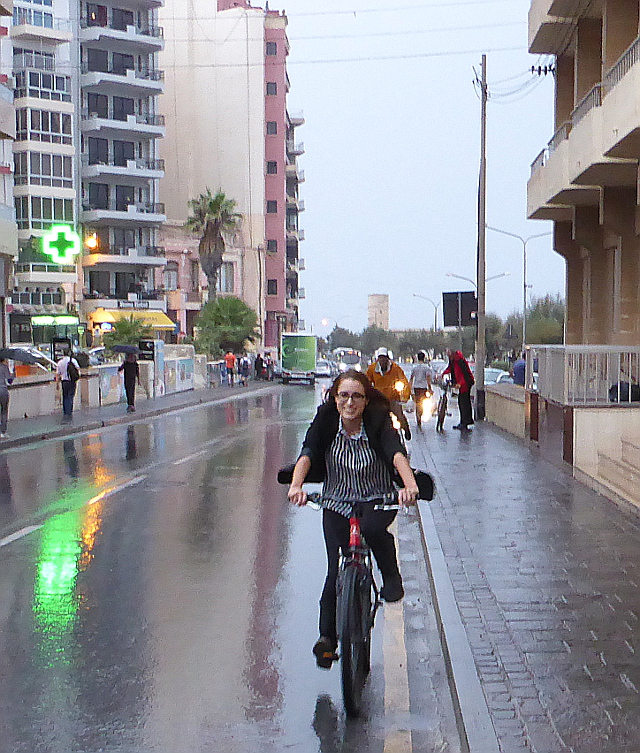
Photo Kevin Mayne

I was in Malta for a workshop as part of an international project to boost cycle commuting which has a Maltese partner as part of a 12 nation consortium. While we were discussing the high potential for further growth by learning from countries like Denmark and the Netherlands we were all sensitive to the huge challenge face by our Maltese friends to get cycling going here, especially at our press conference on the final day.

Photo Kevin Mayne

All week the local paper was full of stories about congestion on the roads and that is hardly surprising given that Malta has the second highest level of regular car use in the EU, one of the lowest levels of public transport use and very definitely the lowest level of cycling, by a large margin. When it comes to cycling it is congested, hilly, hot and has inherited many of its attitudes to cycling from that well known cycling laggard and former colonial power, Britain. I understand that it was probably the Brits who advised the Maltese on their transport policies in more recent years, not a recommendation from cycling point of view.

Photo Kevin Mayne

In fact we seem to have left such a great legacy that our other Mediterranean colony Cyprus joins Malta at the bottom of the cycling league tables. Not a good trend is it. British heritage = rubbish at developing daily cycling, British transport heritage and driving on the left, even worse, a special club combining the UK, Australia, Malta and Cyprus.

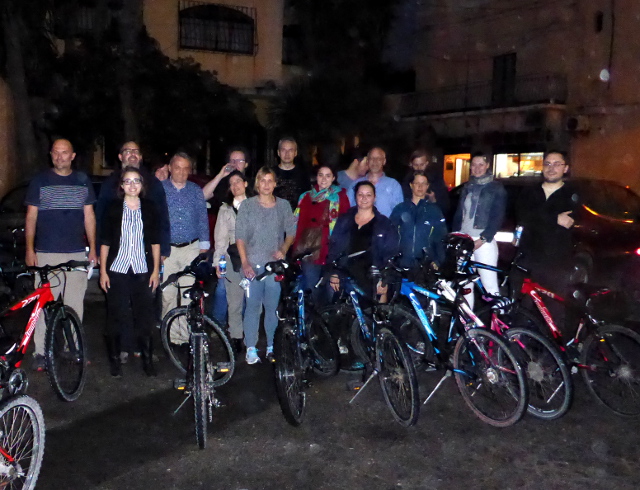
But knowing that we just did what we always do. We went for one of our multi-national bike rides to explore the reality on the ground, 20 foreigners forming a sort of critical mass in the late afternoon gloom.  Then the following day I went for a solo ride despite a very stormy afternoon. So as usual I give you the I Do Not Despair snapshot of another country, with perhaps a bit less “adult on a bicycle” than the normal observations. The photography was even more challenging in the half light, wind and rain so apologies for the blurry edges.

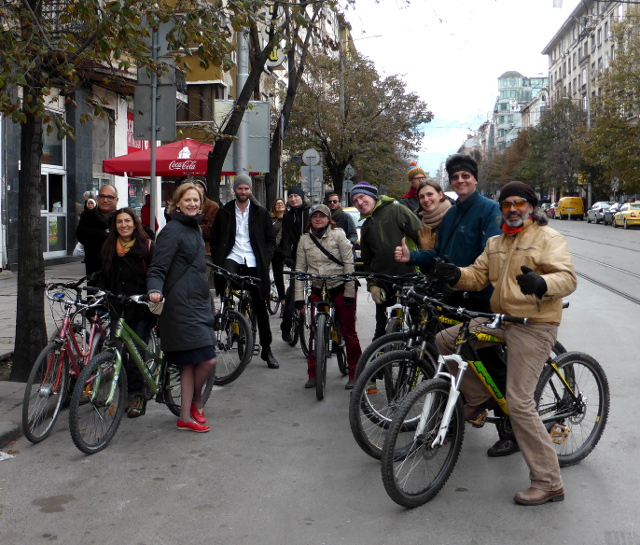
Our group ride left our hotel at St George’s Bay to ride around the coast and inlets of St Julian’s Bay and Sliema, cutting across the steep headlands on the return. Only a few kilometres as the night closed in but a real taste of some of the challenges of Maltese roads. And doing it as a group we had a safety in numbers effect and lots of visibility. Lots of smiles

Photo Kevin Mayne Photo Kevin Mayne Photo Kevin Mayne Photo Kevin Mayne

There were some attractive vistas across the bays, especially the capital Valetta which was tantalisingly close across the harbour.

Photo Kevin Mayne Photo Kevin Mayne

Photo Kevin Mayne

Riding on my own to Valetta a day later I was less confident and spent a bit of time hiding on pavements and promenades which seemed more sensible, but the conditions that night were a bit extreme. (Post to follow)

What was it that led to this reticence? Yes there were no cycle paths and the roads were a bit hilly and narrow, but that is not exactly unusual in many of the places I ride, not least Brussels. No the main problem here was the cluelessness of the drivers. I wouldn’t call them super aggressive, it’s just that they had absolutely no idea how to drive around cyclists because clearly they hardly see any. In fact they weren’t particularly dangerous on the busy city and coast roads because their congestion and the narrow side streets acted as excellent traffic calming.

We got honked at a few times when we were actually doing nothing particularly obstructive or when it was absolutely clear that the street was only just about wide enough for a cyclist so there was no way a car would come past even if we pulled over to the side. When there was a gap the drivers didn’t hang back, they tended to pull up beside us which was disconcerting for our less experienced riders and pushed everyone in to the edge.
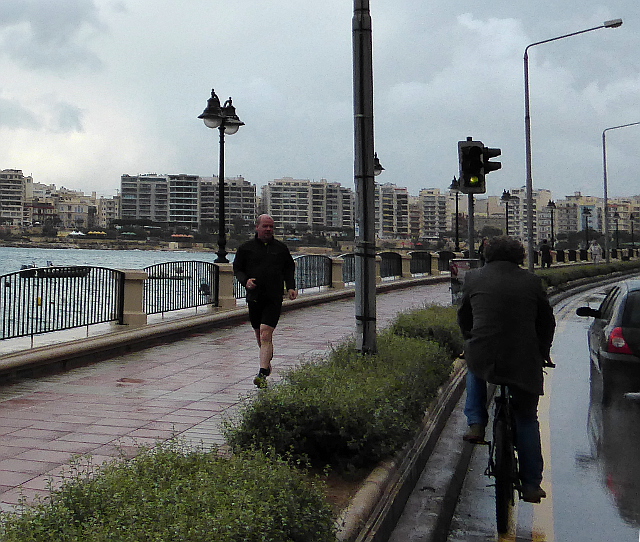
Photo Kevin Mayne

I tried to hang at the back of the group on the bigger roads a few times and take my preferred “primary position”, hanging out into the carriageway to try and deter their encroachment into the group but without much luck.

Photo Kevin Mayne

On my own in the dark and the wet I wasn’t trying the primary position but there was further evidence that motorists hadn’t much experience of cycling or walking when the roads got really wet. The dreaded bow wave, a wall of water sometimes over metre high when the cars accelerated into the puddles instead of recognising that there were people outside the car as well!

I don’t think the roads were so much worse or unforgiving than many other towns and cities with higher cycling levels. But as well as no cycle lanes there was very little other help from the authorities. For example the older areas were a wonderful maze of narrow streets, especially in the capital city Valetta. To cope with cars they have mostly been made into one way streets but that makes navigation around the city somewhat complicated. A simple adoption of universal contraflow cycling across the cities would open up huge networks of streets instantly.

Photo Kevin Mayne

And some parking restraint wouldn’t go amiss either, that could open up a hell of a lot of space and start changing an attitude that the car is king.
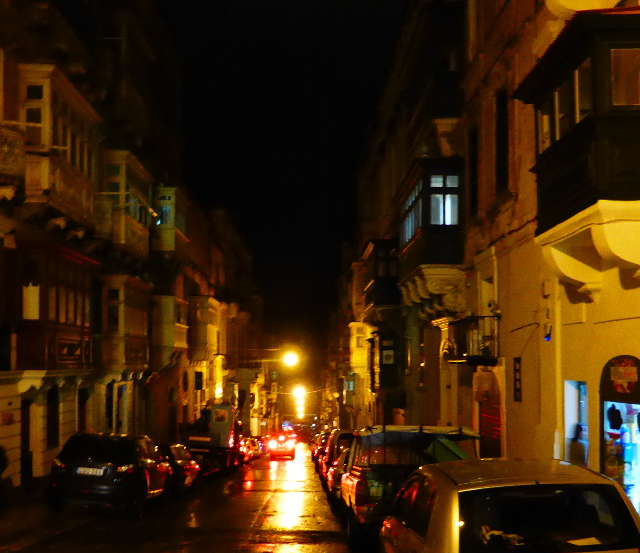
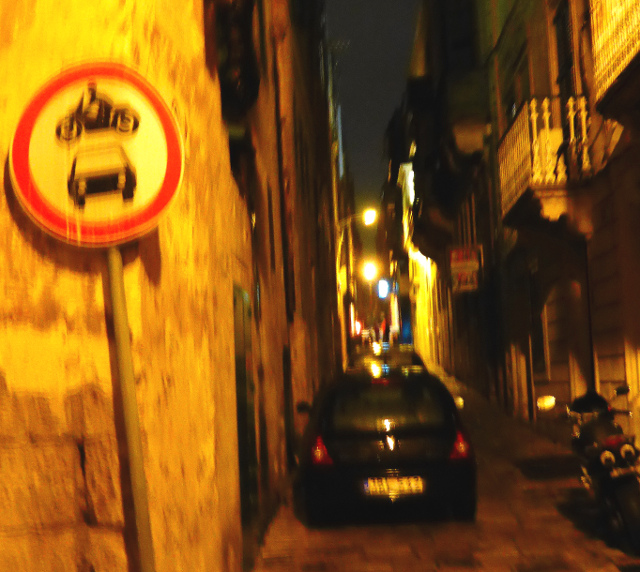
Photo Kevin Mayne Photo Kevin Mayne

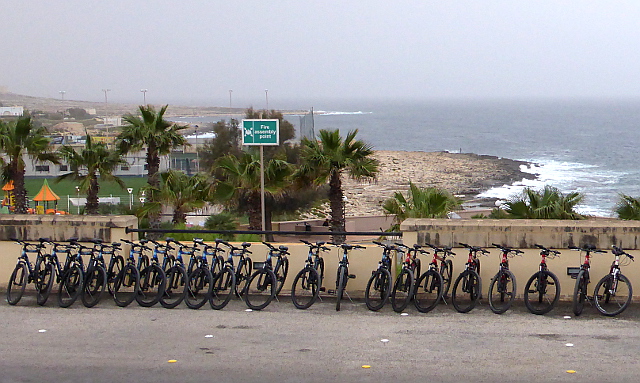
Off season the wide promenades are also perfectly good shared use spaces too, we were advised to use them by our bike tour operator and that was definitely a good call. Great views too.
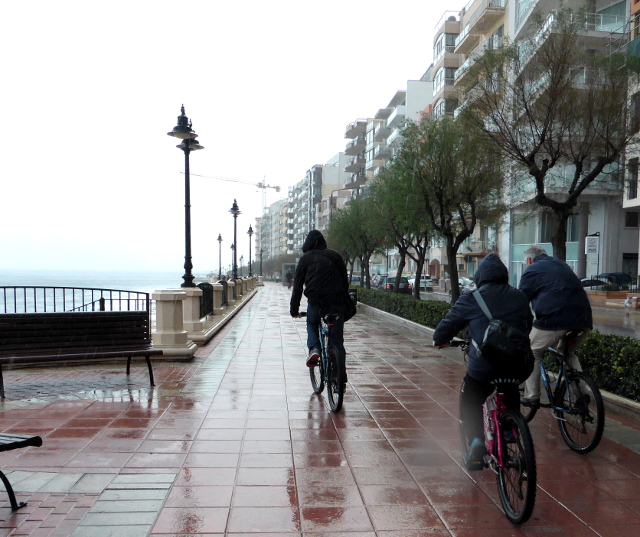
Photo Kevin Mayne

There are undoubtedly some seeds of change and as usual we met some really committed people who want cycling on the island to succeed. Above all the congestion is reaching a point where the citizens and public authorities know something has to happen. And we know from other countries that part of the human rebellion that set cycling going was a reaction to congestion, when cycling is so much quicker and easier than other transport. A chap from the ministry of transport that I met at our press conference also suggested that e-bikes could be part of the solution, probably not a bad move in a hot hilly country. (Our rainy days were far from usual.)

I also heard that local cycling events can get up to 5,000 participants which is great, the cyclists must be out there somewhere and there are groups of cyclists coming here on tour which must raise its status. But it is going to be a long haul, there has to be a critical mass of cyclists that emerges in at least one town or city somewhere on the island to give it some profile and start educating the local drivers. And despite everyone at our press conference agreeing that it wouldn’t be easy they all then went off into little groups discussing great ideas and places where perhaps it would be possible to get people cycling to work.

My thanks to our hosts who made it an excellent trip and a special thanks to Denis Debono from Bybike who provided possibly the friendliest bike hire service I have come across. He provided the bikes, guide and running commentary on Thursday, then he dashed halfway across the island to bring us bikes on Friday afternoon’s ride and made himself available for a call when the storm caused most of the group to give up our ride to Valetta. Highly recommended and a good reason to cycling in Malta.

A brief visit to Sofia, capital city of Bulgaria

Mount Vitosha Sofia Bulgaria

Having written about cycling in Sofia in my previous post this one is about my impressions of Sofia as a tourist in the two brief tours that I took around the city centre in my short visit.

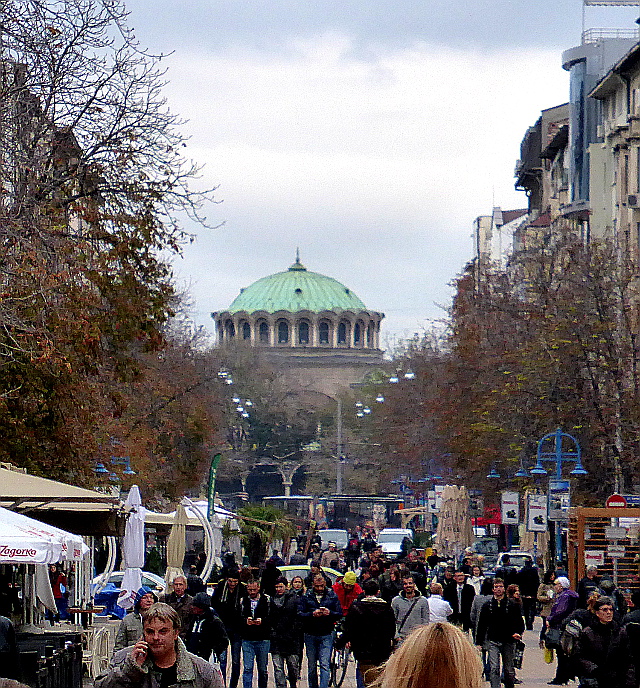
It was very much late autumn here with the first cold temperatures of the year coming in, down to about four degrees centigrade overnight and there was snow on the Vitosha Mountain that overlooks the city. The city was mostly wrapped in a steely grey grip that briefly lightened for our afternoon bike tour but otherwise kept things a bit dull so maybe we didn’t see the city at its best. But I must say the mountain itself is a great landmark as you move about, forever on the skyline and real symbol of the city. I really wish I had enough time to take a trip up there, it looked amazing for walking or mountain biking but it would be a substantial excursion of a few hours.

It would probably be fair to say that Sofia is not one of Europe’s tourism hot spots. Nor one its wealthiest cities, so it has a slightly run down feel with buildings, roads and parks often in need of some repair and restoration. What it has in its favour is a rather sleepy, quiet nature because for a capital city of well over a million people we did spend some time wondering where they were. Little of it is completely car fee except the main shopping drag of Vitosha Boulevard but the main city centre buildings and parks are mainly in two central neighbourhoods which were easily accessible by bike, foot and metro so it was actually a really easy city to navigate.

Photo Kevin Mayne

What Sofia also has is an incredible history. Its pre-Roman history goes back to 4BC, then it was a major Roman centre for nearly 500 years. At times it was part of various Bulgarian empires which brought a Christian heritage but for another 400 years it was part of the Ottoman Empire. In the 19th and 20th Centuries it fell into the Russian sphere of influence with a communist government from 1946-1990. Unfortunately it was flattened and rebuilt several times in that process so much of ancient Sofia is buried under the later layers and it is a bit of a detective exercise to see the differing elements.

What we mainly saw to represent the city history were two distinct groups of buildings.

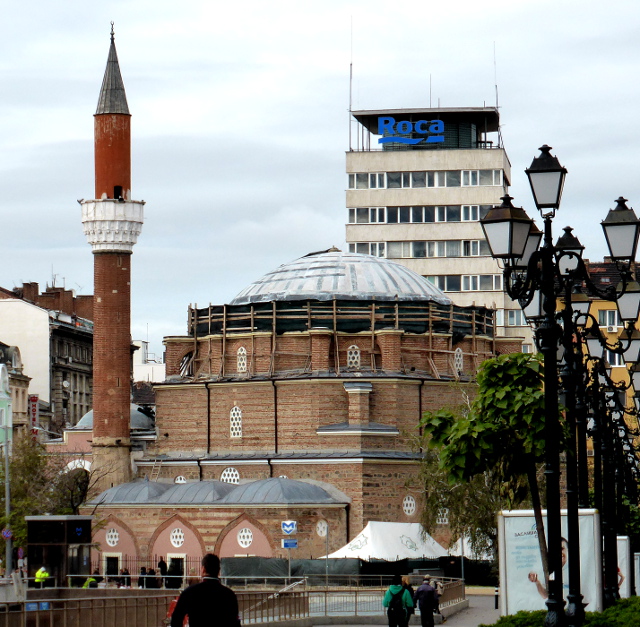
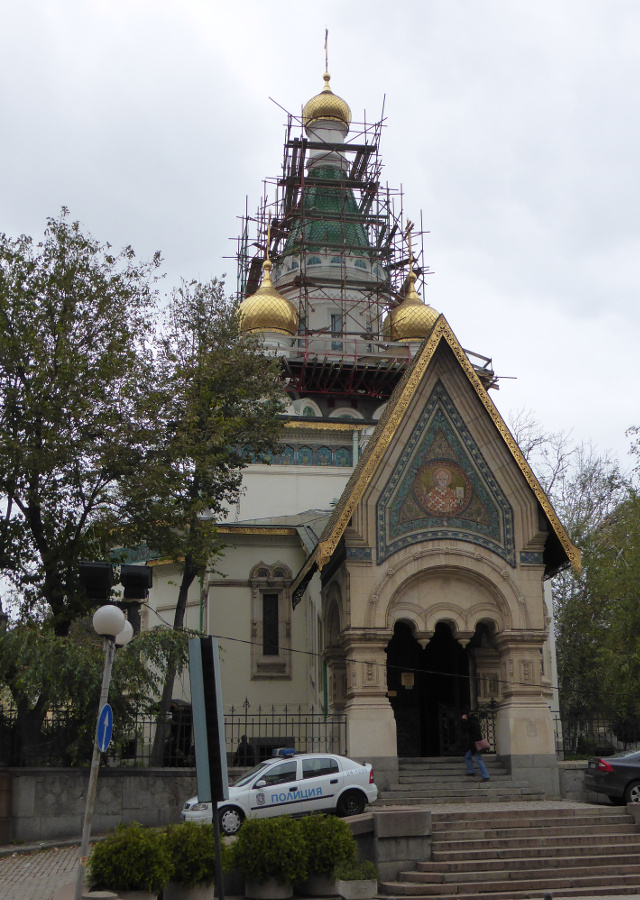
The first were the religious sights – cathedrals, churches, mosque and synagogue reflecting the diverse heritage of the city.

Photo Kevin Mayne Photo Kevin Mayne

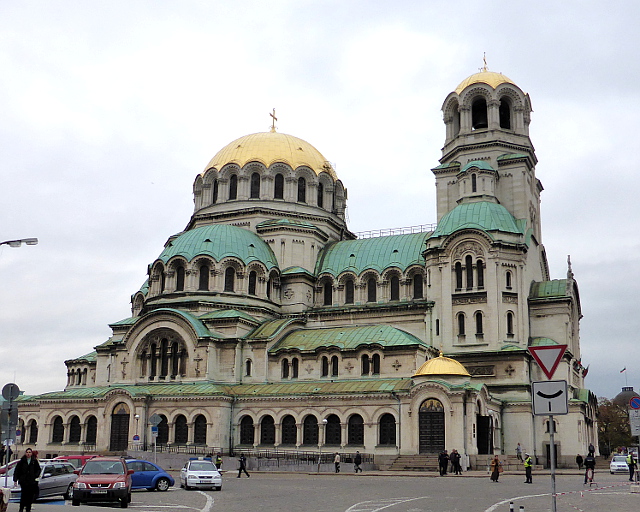
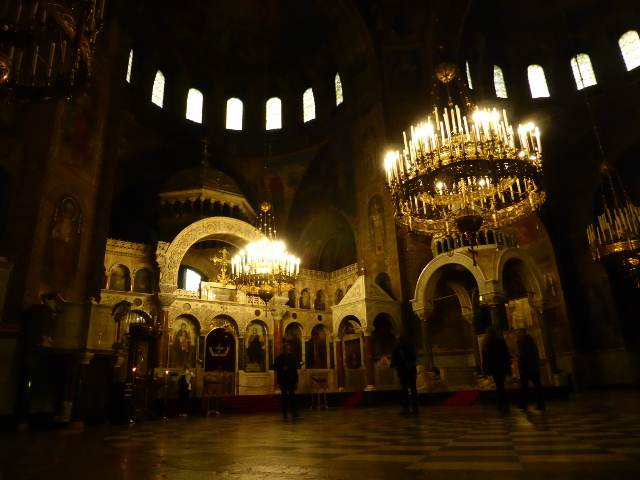
Chief of these was the Alexander Nevsky Cathedral which turned out to be quite a surprise for me. From the outside it is a giant of white and gilded domes.

Photo Kevin Mayne

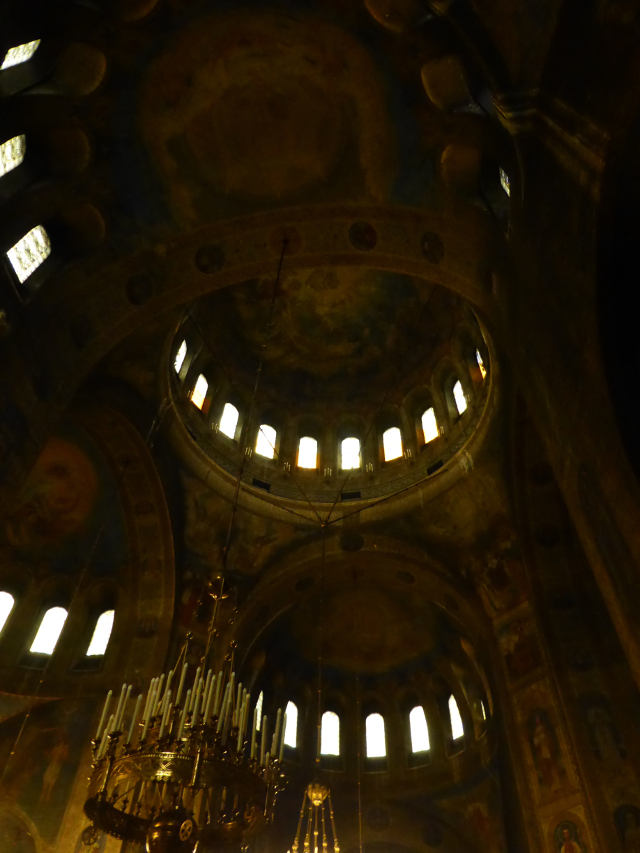
But inside it was dark and unlit except for tiny windows up in the dome and large groups of candles. One could sense the detailed painting on the walls and up in the heights the dome could be brightly decorated but it was the darkest, gloomiest major cathedral I have ever been in, almost cave-like.

Photo Kevin Mayne Photo Kevin Mayne

By complete contrast the tiny Saint Petka Church was a medieval church sunk below the level of the city roads close to excavations of the old city which are being unearthed in front of a new metro station, one of the few surface signs of an older Sofia.

Photo Kevin Mayne

The second group of buildings reflect the more recent Soviet past. Almost inevitably there is a huge block of Soviet architecture of which the most striking was the former Communist Party Building, the Largo building which is a classic of its type.
Photo Kevin Mayne

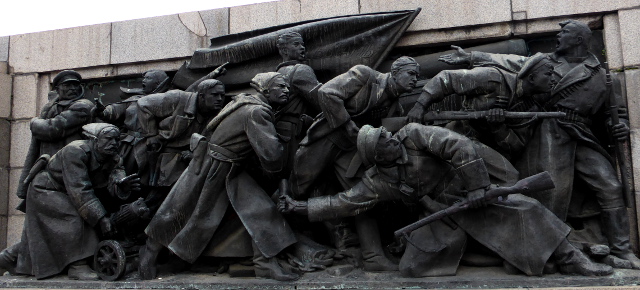
The memorial to the Soviet Soldiers also survived the end of the communist period in a small park to the west of the city centre with its dramatic statues and friezes.

Photo Kevin Mayne Photo Kevin Mayne

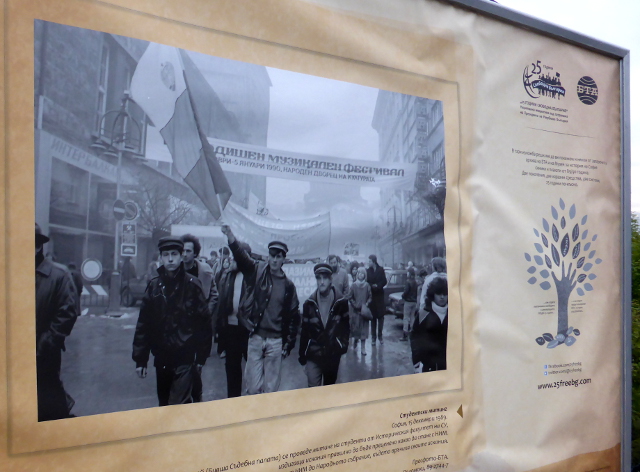
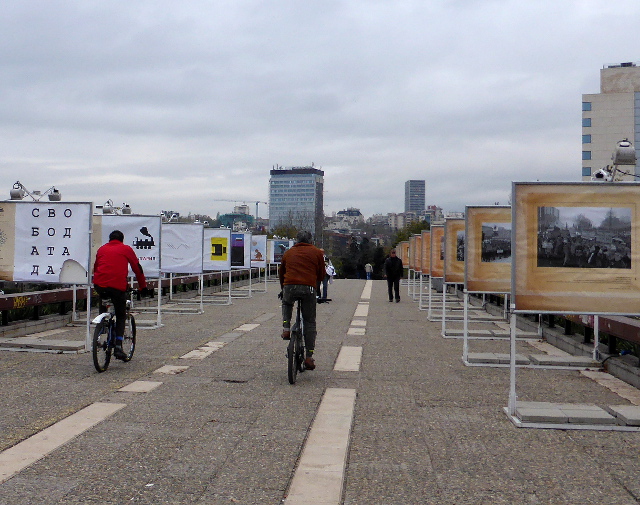
The complete contrast to the features that represented the communist period was a display near the National Cultural Centre which celebrated 25 years since the end of communism. There were evocative photographs and logos from the period right across the bridge, although I couldn’t help but be amused by its proximity to the drive-through McDonalds – was this what the revolution was for?

Photo Kevin Mayne Photo by Kevin Mayne Exhibition poster of 25th Anniversary of fall of Communism Sofia Bulgaria

Other highlights were the National Theatre and the attractive gardens out front.

Photo Kevin Mayne Photo Kevin Mayne

In addition to the physical sights of Sofia I have to say that everyone we met was incredibly helpful and welcoming, from our hosts to hotel staff, restaurants and cafe staff. They went out of their way to make us welcome at the Bulgarian themed restaurant – traditional dancing a bonus!

Photo Kevin Mayne

And a thank you to the bar staff on Vitosha who said they were closing, and then kept the doors open as long as we were there. I guess that is the advantage of being the only customers in town!

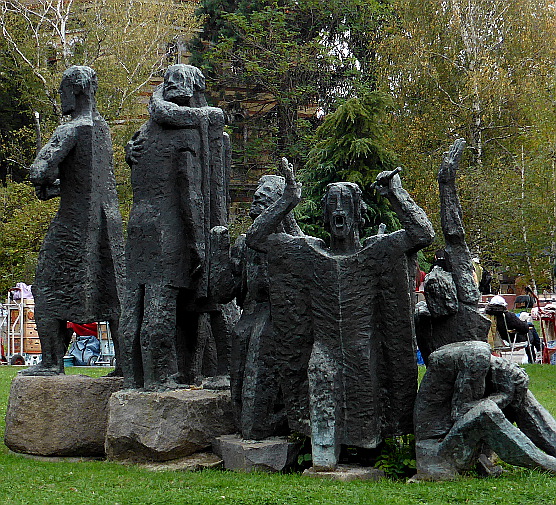
I leave the post with pictures of some striking statues in a square just in front of the Alexander Nevsky Cathedral. My research has failed to turn up their subject but I found them quite moving.

Photo Kevin Mayne Photo Kevin Mayne

Cycling in Sofia, Bulgaria – positive observations from a short visit

Time for another “Idonotdespair” moment, trying to get a snapshot of the cycling culture in a new city through the eyes of local activists, a short ride and some general wandering about. I was in Sofia, capital city of Bulgaria for three days this week which included a guided cycle tour of the city centre and a similar walking excursion. I have broken my usual collection of photos and comments into two posts, this one about the cycling experience and then a few tourist notes in a few days’ time.

I think the cycling can certainly be summarized as “far better than expected” because the country hovers towards the bottom of most European cycling league tables and expectations had been set fairly low by our hosts. But I found a lot of positives and yes it was so much better moving about by bike than walking!

We were in Bulgaria with delegates from small and medium sized cycling organizations as part of a programme to support European groups that are trying to make the jump from smaller, informal structures to try and create a national impact. So I wasn’t there on my own and that helped keep the differences in perspective. Coming to Sofia from the low cycling countries like UK, Greece, Ireland, Czech Republic and Ukraine it really didn’t feel vastly different to home, so we of course were able to share our experiences as “kindred spirits”. On the other hand at least one person in the mid rank of cycling nations who joined us (Austria, Finland, and Sweden) said she certainly felt a bit better about her home city after cycling here.Photo by Kevin Mayne

First impressions were not great. In the taxi from the airport we were faced by nose-to-tail traffic queues and wide high speed boulevards that made me suspect that this was another east European city that had embraced the car with enthusiasm in the last 25 years. It was not until we reached our city centre hotel that I was delighted to notice a cyclist, inevitably a hipster on a fixie jumping a red light. There must be a factory somewhere in Taiwan that just creates them and sends the whole unit over to Europe as one item, person, bike, trendy beard and colour-blindness included.

Photo by Kevin Mayne

The start of our group bike tour the next day confirmed some of the poor impressions. We were cycling on multi-lane roads or encouraged to share the lumpy, poorly repaired pavements with pedestrians, neither of which was particularly appealing. The infrastructure gave no help knowing which route or what positioning on the road to take. Our guide did point out a few places where there were once cycle lanes and the paint had worn away and suggested the city really didn’t know what to do with cyclists now. I was very grateful that we did have a host to start with, it gave confidence that we were actually riding in an accepted manner. (Although more of that below)

Photo by Kevin Mayne

Throughout the trip I noticed that the city had the parking plague, every street, spare corner and open space seemed to be covered with parked cars and they were often double parked, pushing us out into the traffic. In that it reminded me of Kiev, Ukraine, because there was potentially a lot of space for cycling facilities but no space to install them without taking on the parking menace.

Photo by Kevin Mayne

Nice cobbled streets around the National Theatre offered the possibility of an attractive slow moving network of cycle friendly streets like I had seen in Madrid in September, but the parking was still intrusive and not well controlled. The road surfaces were pretty awful too but after three years of Belgium I hardly take that into account any more, I rather regard it as a form of traffic calming.

Photo by Kevin Mayne

Towards the end of our tour we turned back towards our hotel along Vitosha Boulevard, the main shopping street of the city that gets its name from the dramatic snow covered Vitosha Mountain that is visible on the skyline right along the street.

Photo by Kevin Mayne

By the time we did so I was in a thoroughly good mood from the cycling and beginning to quiz my colleagues about what I had seen and felt on the ride. Because I certainly wasn’t getting the impression that this was a frightening, anti-cycling city. That impression was reinforced the next day when some of us walked around other areas.

Most importantly of all I felt that the drivers of Sofia were some of the most patient and well behaved I have come across. Seriously! It seemed common to just to wander out into the street and face down the cars which proves to me that is far from a car dominated city centre. At no point was our large group honked at and passing distances were well respected. Whenever a pedestrian or another cyclist just wandered out into the carriageway or attempted a pedestrian crossing the motorists stopped almost instantly so we started doing it too.

Photo by Kevin Mayne

Turning at junctions the traffic didn’t race off, people were able to cross and in the small streets traffic speed was very sensible, especially in the numerous 30kmph speed limit zones.

The other thing that struck me was that the numbers of pedestrians and cars was incredibly quiet for the centre of a large European capital on a weekday. I kept thinking I must be missing something such as a public holiday, but apparently not. There were definitely traffic jams out on the peripheral roads and arterial corridors but it really was quiet and sedate to get around by bike in the city centre. I wonder if it is the traffic management that makes everybody so patient, the waits at traffic lights were never ending? However in most cities where cars queue at traffic lights it seems to make them impatient and grumpy, here I just didn’t get that impression. It may be that we were the beneficiaries of a significant police presence, especially at larger junctions where they still have these brilliant little control boxes that sit up above the street corner and manually intervene to control the traffic flows. How old school is that – brilliant!

Photo by Kevin Mayne

When we walked a bit beyond the city centre we came to some of the many parks that run around central Sofia.

Photo by Kevin Mayne

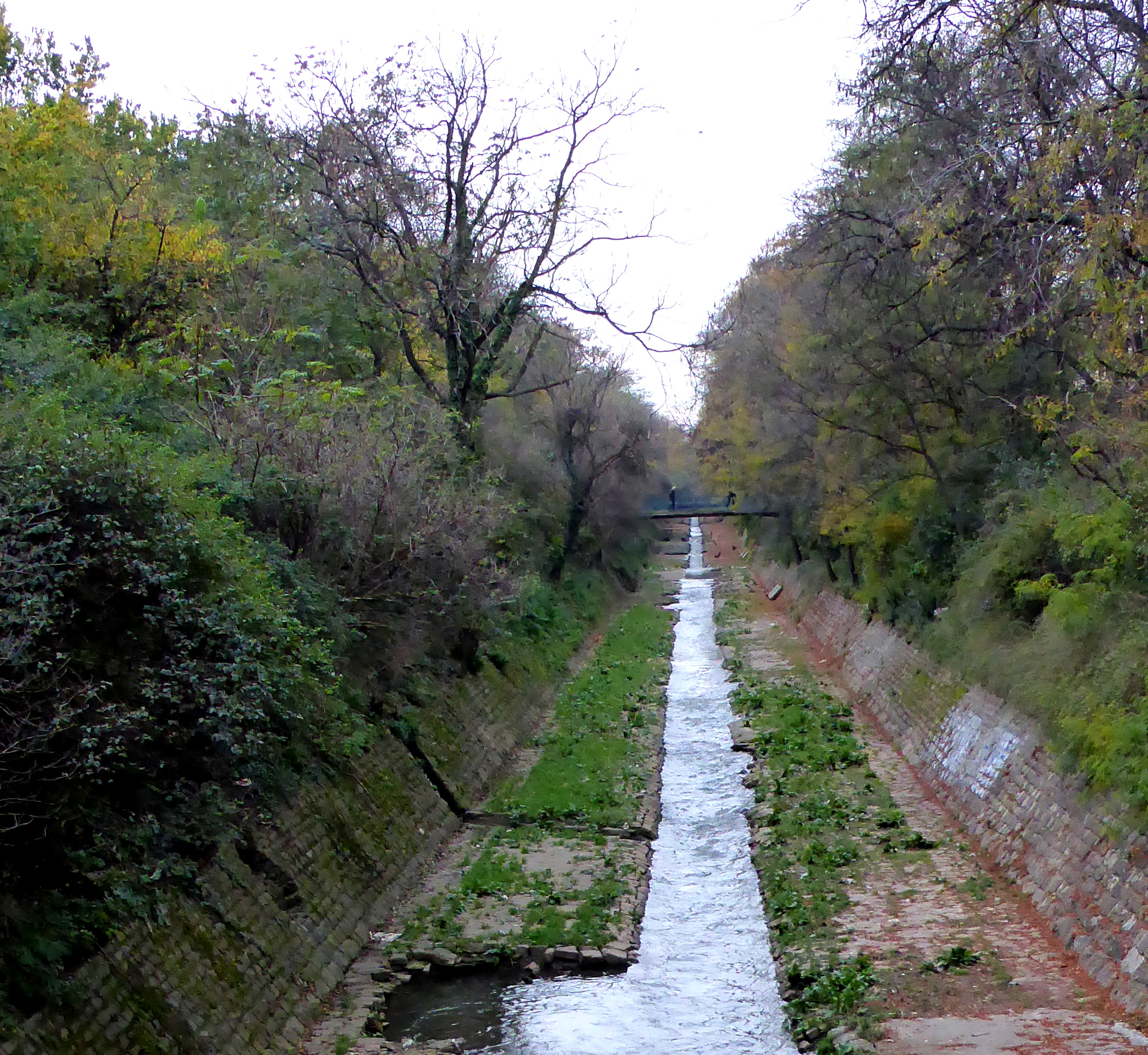
Here there were networks of quiet car free paths and alongside the canalized Perlovska river there were long cycle lanes looping around the south of the city centre. They too were not in wonderful condition, but they were there, and being used.

Photo by Kevin Mayne

Photo by Kevin Mayne

The last discovery of the trip turned out to be just near our hotel where we found a large, wide cycling and walking bridge linking the National Cultural Centre to the southern suburbs, allowing people to cross a really nasty main road into the city centre from their residential areas.

Photo by Kevin Mayne Photo by Kevin Mayne

This is the kind of infrastructure we desperately need to fill missing links in our networks in so many cities and here was a perfect example in a place that is supposedly really bad at infrastructure. How confusing.

It was a bit spoiled by the nasty collapsed drain cover on the down slope but most of the locals seemed to know it was there, the BMX riders jumped it and the oldsters went round.

Photo by Kevin Mayne

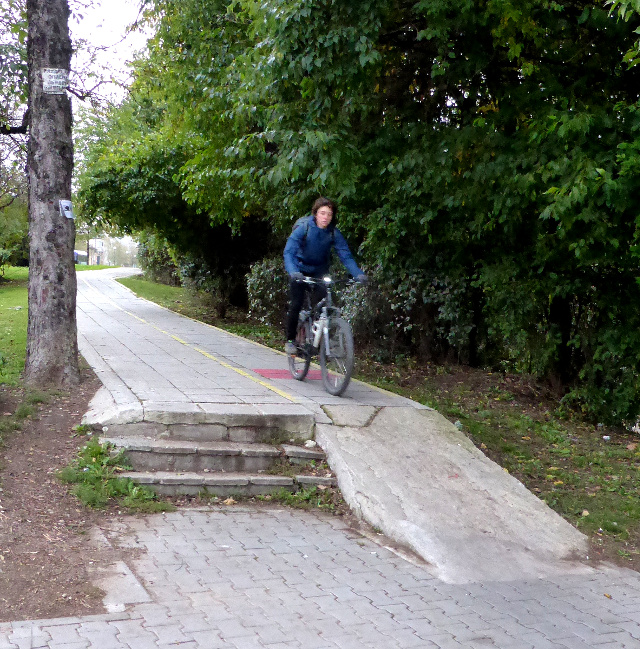
Because there were cyclists. Not in huge numbers but almost everywhere we went in the city there were just ones and twos pottering about on the streets and pavements. No it wasn’t a lot and I could see that they probably didn’t add up to more than the 1% mode share claimed in the published statistics. But they were there and it wasn’t just the cool dudes. We saw older people, mothers with children on child seats and younger women which also suggests that the environment was not totally hostile to all but the fearless.

What surprised some colleagues more was the bikes. They were 90% cheap mountain bikes, only occasionally did we see a more equipped city bike. Again those of us from low cycling countries were less surprised, a population that doesn’t cycle much and therefore doesn’t understand the need to pay more for mudguards, a rack and some city tyres is just what we experience all the time. We did conclude that fat tyres and suspension was probably a good idea when a lot of Sofia cycling seemed to involve bouncing up and down kerbs but we know that you have to build up the population’s knowledge quite a bit more before the better equipped bikes become more common.

Photo by Kevin Mayne

So I leave Bulgaria slightly puzzled by my cycling experiences in Sofia. In many ways this was like my experience of Berlin with its wide streets, quiet traffic and well enforced traffic laws. And in that context cycling could and should flourish because the traffic jams on the arterial roads were bad and there is only a two line metro service to fall back on.

I guess cycling really hasn’t set down new cultural roots in the city and it is going to take a slow steady campaign of promotion and a lot more commitment to cycling infrastructure before it takes off, if only to help people know where and how to ride.

Photo by Kevin Mayne

What this place needs more than anything else is more cyclists because a visible group on the streets riding around safely will do more than anything else to show what is possible.

Probably I got an artificial impression in the centre because the traffic did look more aggressive further out. But there was a huge maze of minor streets around the suburban apartment blocks which could be bike friendly. Of course what usually fails in those circumstances is crossing the big roads and I may be wildly over optimistic from what I saw, any bike route is only as good as its most challenging junction because that is the one people won’t cross. But I couldn’t help but feel the city centre is a good destination for cycling, there must be something to build on there and I would certainly ride there on my own on a return visit.

Now we will do what we can to help our passionate friends at the Bulgarian Cycling Association and their allies to take advantage of what they have because it will be a long road to build up a cycling culture from such low numbers.

Photo by Kevin Mayne

But it is possible that their underlying conditions are a lot more tolerant than in many other countries.

I do not despair.

Book Review: Along the Med on a bike called Reggie

Along the Med on a Bike called ReggieI don’t get round to doing many book reviews from my cycling library but I feel Andy Sykes latest offering is well worth a few words, probably because I just like Andy’s attitude to cycle touring which is a triumph of curiosity and enthusiasm overcoming his self-declared naivety about the more mundane processes of cycling such as how to pump up a tyre!

As the blurb says this is his self-published account of his summer 9 week trip from the southern tip of Greece right across Europe to the Atlantic coast of Portugal, nearly 6000km and 10 countries. He loosely follows the route of Eurovelo 8, the Mediterranean Route but very much creates his own itinerary and diversions, not least to the legendary Mont Ventoux, cycling’s “Giant of Provence”.

It is a sequel to his 2010 trip “Riding across Europe on a Bike called Reggie” where we first met an even less prepared Andy and Reggie cycling from the UK to Brindisi in southern Italy along Eurovelo 5.* I enjoyed the first book a lot, there were some highly amusing moments all along the way so I was looking forward to book 2 when I heard Andy was off for more in the summer of 2013.

The cycle touring book has a long tradition going back almost to the invention of the bicycle. Some of them are voyages of discovery, some epic endurance adventures. The ones I enjoy most are the ones where the personality of the writer comes through and Andy certainly wins on that front. His writing is strongest where he addresses his own feelings – sometimes curious, sometimes anxious, even at times a bit nervous about hills, main roads, the state of the local campsites and arriving in Portugal in his allotted nine weeks. And then the other Andy takes over and just does it, delighted by the small pleasure of cycling travel like wonderful views, chance meetings, yet another coffee in a town square, a day completed. Occasionally he even lets an inner epic cyclist come out and like his day cycling over 200km to Valencia and he is drawn to master the incredible Ventoux, a legendary mountain of the Tour de France. I think the book is best in the first half when he has the time and relaxation to potter about and take side diversions in countries like Greece, Albania and the states of former Yugoslavia including Montenegro, Croatia, Bosnia and Slovenia.

Both books make an excellent introduction to these long distance routes and the concept of using a bike to have an epic adventure.  Andy is also the first cycling writer I have discovered from what I can only call the “on line” generation. He may hardly have a functional map of most of his route but he has got an I-Phone strapped to his handlebars, a solar charger on the back to keep it powered, an I-Pad in the pannier, hotels booked during the day by the internet, guest homes from the cyclists hospitality web site Warm Showers and he has kept his on line community in contact with his travels by Facebook, blog and Twitter. I think many tentative cycle tourists could be encouraged and inspired to take even a short adventure by Andy’s travels across Europe with limited preparation but confidence in his resources. If you know someone who needs a push to try a bit of a cycling adventure but loves their electronic toys this could be the perfect Christmas gift, but of course they would download it as an e-book! I am trying to be this relaxed about my touring, I think a bit of the Andy Sykes approach is starting to rub off.

You can find links to the books and the various points of sale on Andy’s lively web site cyclingeurope.org which also has his blog and lots of other content.

If you like this you’ll probably also like “One Man and his Bike” by Mike Carter and “French Revolutions” by Tim Moore, both mentioned in my library page

Eurovelo.com

(*Declaration of interest here, the wonderful 70,000km Eurovelo network with its amazing long distance cycle routes is a product of the European Cyclists’ Federation who I work for in Brussels. Thanks to Andy for some enthusiastic promotion of the network, even if he does frustrate some of our colleagues by “not sticking to the proper route”. Personally, that’s what I would do, use the routes for inspiration and then make my own way, so no problem here!)

Cycling in Madrid – great potential but major frustrations

Gallery

This gallery contains 19 photos.

My experience of Madrid cycling was one of complete contrasts. If I just spent my time in the trendy inner city districts I would have concluded that this was a cycle friendly city and the city’s hipsters were acting as … Continue reading

Lunch with attitude. Is this the ugliest meal in Madrid?

Arrived in Madrid today to speak at the Unibike cycling trade show at the weekend.

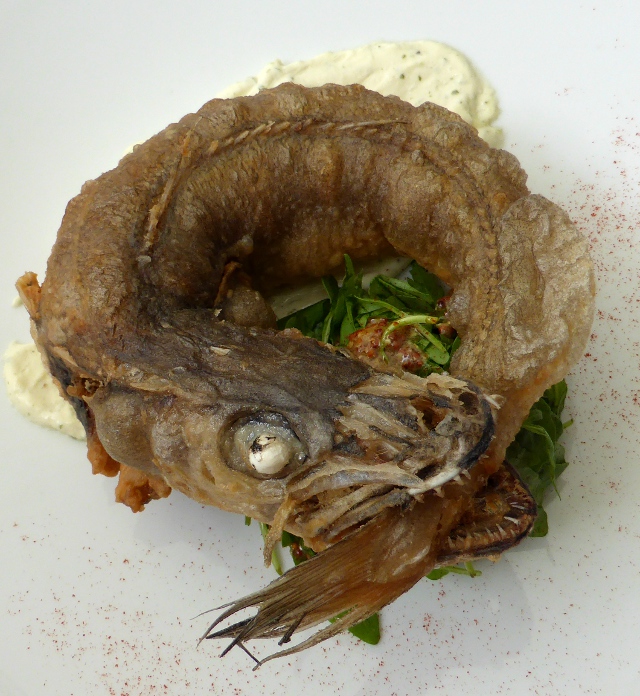
The presentation of lunch was initially very off-putting – but in the end very tasty.

Who had the idea that fish simulating crocodile eating itself made the food more interesting? A high risk strategy indeed.

Photo Kevin Mayne


Photo Kevin Mayne

Nice setting though.

Plaza del Ildefonso Madrid


My Eurobike hotel room – in Weingarten Abbey, Church and Shrine of the Holy Blood, Weingarten, Germany

One of the great pleasures of travel is when you are given a totally unexpected treat.

I have just spent the week at Eurobike, the great bike industry frenzy at Friedrichshafen on the banks of Lake Constance. That in itself is a bike lover’s indulgence of which there will be more later. But this year I got a bonus.

As far as I knew our German colleagues had booked us into some sort of college near Ravensburg which was offering a good package for the week. I thought no more of it, and I had certainly not checked anything other than the directions when I arrived at Ravensburg train station.

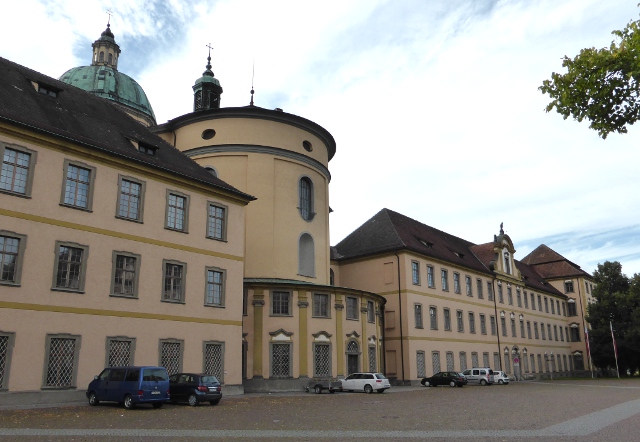
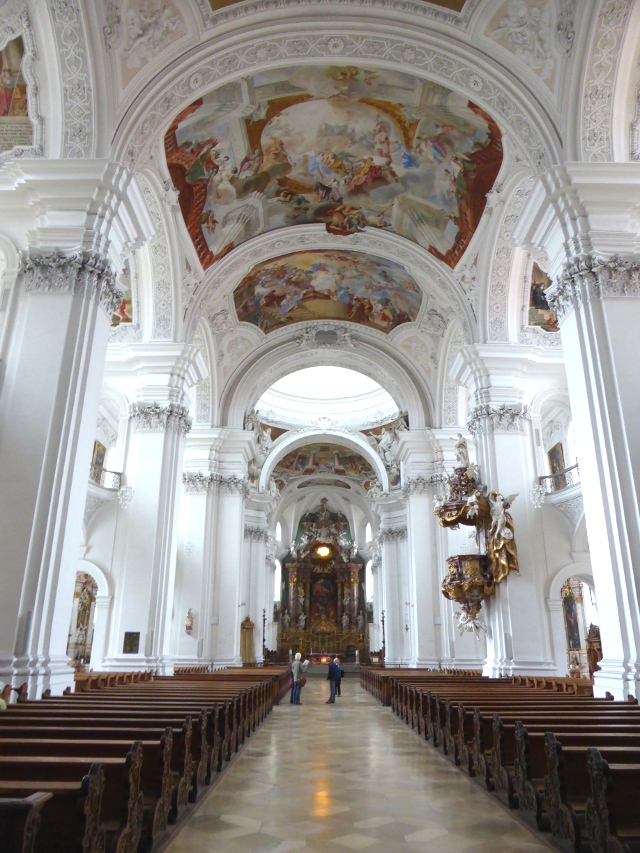
When the taxi driver pulled up on the forecourt of a huge church complex overlooking the neighbouring town of Weingarten I was quite convinced I must have misread something, until I was warmly welcomed at the Conference Centre in the Benedictine Abbey and Basilica of Weingarten, the largest Baroque church north of the Alps and an important religious site for over a thousand years.

Photo Kevin Mayne

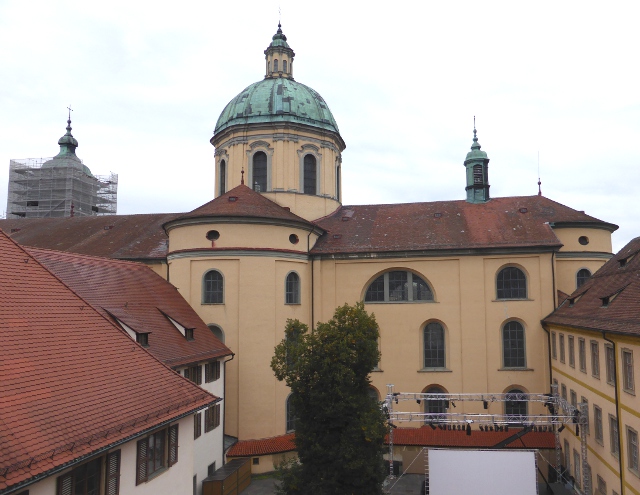
One wing of the former Abbey is now a training centre and conference suite for the Diocese. So that is why I found myself throwing open my room window to discover I had a view over a courtyard and the great dome of the Basilica, nicknamed “Swabia’s St Peter’s”. It may have been a bit cloudy and gloomy but the setting lifted me up after ten hours of train travel.

Photo Kevin Mayne

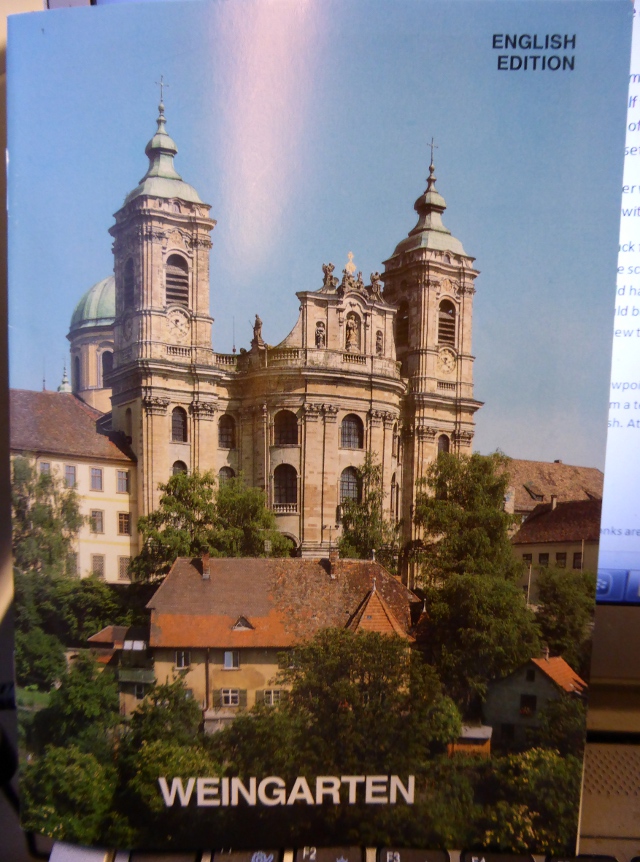
The next evening after work I was able to wander the grounds and discover more about where I had ended up, especially with the help of a little guide book I bought in the Basilica.

Photo Kevin Mayne

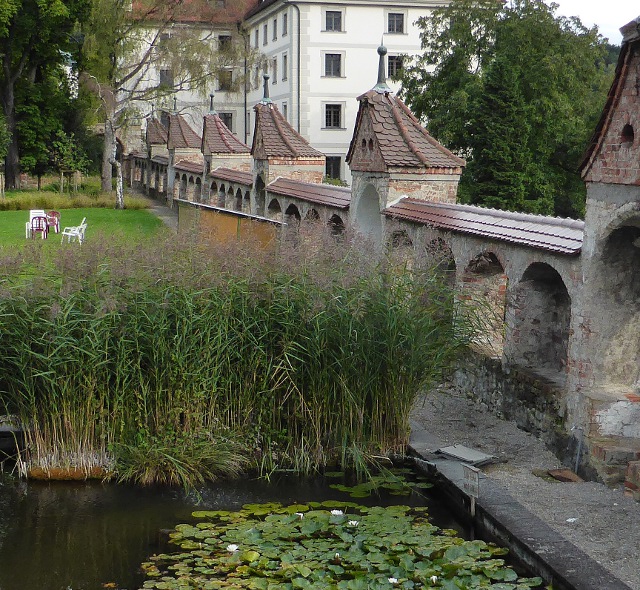
It was hard to step back far enough to get a clear view of the buildings because they were constructed on a huge scale and the Basilica itself was flanked by two large wings, each around a courtyard which would have formed the cloisters of the abbey when it was at its peak. From ground level this inner perspective was of one of somewhat severe and austere walls, probably not what it was like before its final phase of building in the 18th Century.

Photo Kevin Mayne

Photo Kevin MayneThe only way to see its original style and scale properly was looking up from the town below. Unfortunately ugly restoration work and grey weather deprived me of that view this time so I had to rely on the image from the guide book to help me imagine it.

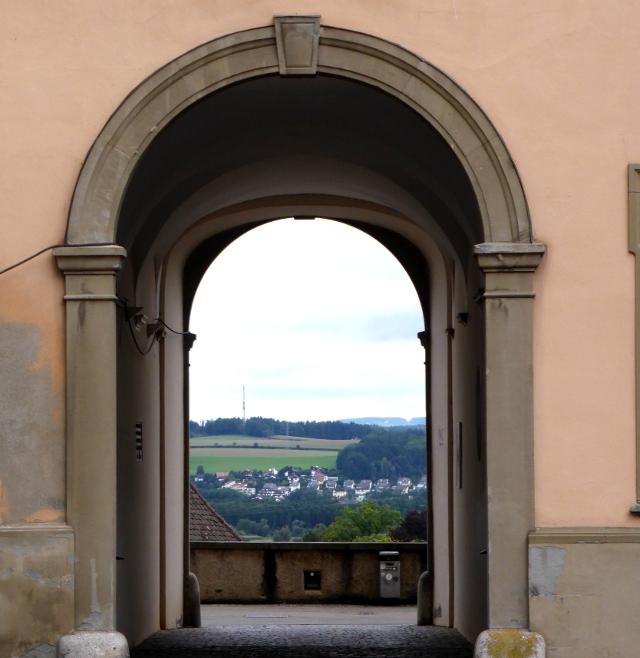
Looking out from that viewpoint at the front of the church I did have an excellent view down over the town itself, looking from a terrace that has been planted with vines to recognise the town’s name – “Wine garden” in English. At dusk groups of young people gathered here to chill out, have a beer and watch the sun set.

Photo Kevin Mayne

Photo Kevin Mayne

Inside the Basilica there is a totally different perspective. Firstly I could really sense the scale which I had found it hard to identify from outside. Apparently it is over 100 metres long and the dome goes up over 60 metres.

Photo Kevin Mayne

And there was certainly nothing plain about the inside, the white masonry made it seem light and bright and contrasted with the splashes of gilding and paint in all the alcoves and up onto the ceiling.

Photo Kevin Mayne

I have no particular religious affinity with any of the churches and temples I visit when I am travelling but particularly in Europe these buildings are a vital part of our landscape and heritage, it was a rare treat to be able to say I was staying in the “spare room” at the Weingarten Abbey.

There is however a footnote to my tale.

One of the nice features of my first night was to see the courtyard in front of my room being used as an outdoor cinema for the town, a great setting with a nice atmosphere, towers above and bats flitting around. It is apparently a summer season feature of Weingarten and a nice symbol of the multi-functional use of the complex by the regional government who now own it.

Photo Kevin Mayne

But the volume was incredibly high and I did wonder to myself just how long they might be going on when I wanted to go to bed. It was nice when it stopped, but only then did I appreciate that the cinema sound had to overcome the church bells which rang out every 15 minutes. We had a discussion later amongst our group whether they actually continued all night; the lighter sleepers were convinced they did. From the third floor, not so far from the bell tower itself I can categorically say they chimed 12 times at midnight and for sure they were going again at 5.30am.

I think we have to assume that the bells are part of the setting. Personally I am not complaining, but I am not so sure about some of the others!

Further post-script – last year’s accommodation wasn’t bad either – this is a great area to visit. Click here for more about my stay in Ravensburg.

Flanders cycle tour day 3 – Bicycle Paradise.  Geleen, Maasmechelen, Hoge Kempen National Park, Genk and Hassalt.

Gallery

This gallery contains 17 photos.

I keep wanting to write that that this trip was a “Tour of Flanders”. However the cycling traditionalist part of my brain keeps telling me that the name Tour of Flanders is reserved for Ronde Van Vlaanderen the great one … Continue reading

Day 2 of our Round Flanders Cycle Tour: “A tale of two Limburgs – Belgian and Dutch” From St Truiden to Tongeren then across the border to Maastricht and Geleen.

Gallery

This gallery contains 21 photos.

Today’s route was multinational. We started aiming to cycle round Flanders but it was impossible to cycle past the famous Dutch city of Maastricht without paying a visit and after that some minor navigation errors saw us spend the afternoon … Continue reading

Cycle touring East Flanders – Discovering Leuven, Hoegarden and St Truiden

Gallery

This gallery contains 22 photos.

This was our first day riding together, very much finding out the pace and rhythm that would suit us both. It was also a really good taste of the Flanders Cycle Route because we were treated to a wide variety … Continue reading

Ingredients for our perfect cycle tour on the Flanders Cycle Route.

Belgium Flanders cycle touring

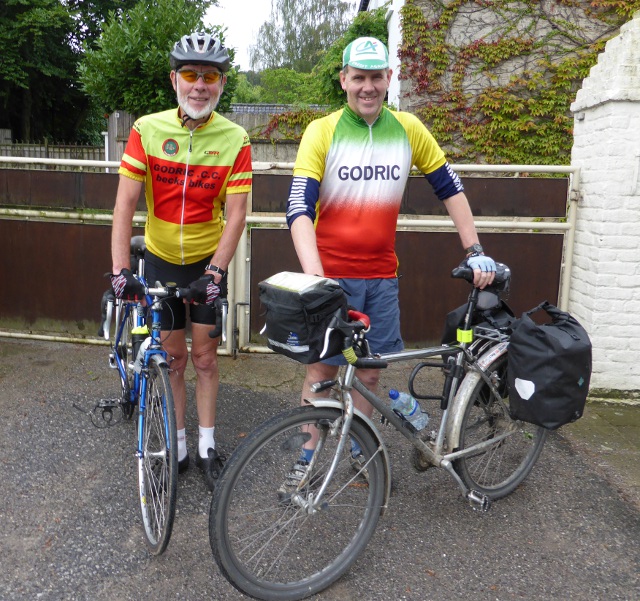
My Dad and I have just returned from three days really excellent cycle touring in East Flanders and its borders with the Netherlands. Before writing up a typical travelogue I was musing on what made it particularly successful.

We have both done a lot of touring over the years and we had a very clear idea of what we didn’t want. We didn’t want the sort of trip where the cycling gets in the way of the touring. Or more probably the cyclists got in the way of the touring, the sort of trip popular with cycle tourists who have a very fixed view of what constitutes a day’s cycling.  I have of course done these rides, and enjoyed them enormously, especially afterwards. The trip where there is a consensus that we are going to sixty miles a day come hell or high water. Or where the organiser has booked hotels exactly xx miles apart in a straight line and we are just going to have to get there, even if we arrive in the dark when the chef went home hours ago. Other symptoms include arriving at a place of beauty and riding straight past because we are behind schedule, or probably worst of all discovering a set menu of exquisite local food for just €15 and going in the café next door because we can see the bikes from there.

Legends are born on trips like that. But that isn’t what we wanted.

We wanted the other sort of cycle tour, where the cycling is a means of exploration and an excuse to spend a few days just chatting and putting the world to rights. And for various reasons we both needed something that was entirely relaxing. As we haven’t actually toured together overnight for many years we also had to work out something that made sure we were on the same wavelength too.

So we compared notes on some important ingredients and then discovered that East Flanders was absolutely perfect recipe for our needs. This was only a relatively short trip, others may indeed set off to cycle round the whole of Flanders, of Europe or indeed the world. But for us it was just right. If the Mayne rules ever help you design a future tour then please feel free to steal them.

1. If the plans get in the way of the enjoyment, ditch the plan.

2. It’s not about the cycling, it’s about the trip. Stop lots. Especially in the proximity of a café. (see 7)

cycle touring in Belgium

3. Don’t go anywhere.

Yes seriously. A few days before we were due to set off I was beginning to worry about where we should go. Maybe the Ardennes, maybe a Eurovelo route? Somewhere by train, car or bike? We need to get out and see some more of Belgium don’t we?

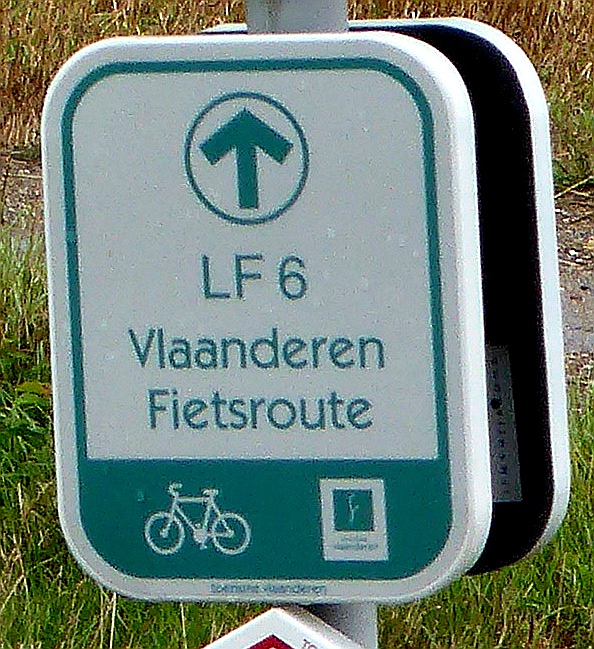
And then a booklet for the circular Flanders Cycle Route which meanders some 800km through the five Flanders provinces sort of fell off a shelf into my hand and I made two important discoveries. Firstly that it passed just 10km from my house and secondly that I hadn’t actually ridden any of the areas in that Easterly direction. So I thought “why bother doing anything else?” It is mapped, signposted and starts on the doorstep. Wherever we end up we can get a train back. Let’s just give it a try.

Flanders cycle route sign Photo Kevin Mayne

4. Distances are to be measured at the end of the day, not set at the start.

This was a particularly successful strategy. I had predicted roughly where we would end up each night based on the straight line distances between some of the towns but we discovered that the winding route added a considerable distance on each stretch so my predictions were way out. But because we had neither planned nor booked anything it really didn’t cause any stress at all.

The wonderful Knooppunt navigation points* help with that too because at each junction you are pointed to the next Knooppunt but no distances are given. So you just potter on to the next number, and then choose a new one depending on how you feel.

Photo by Kevin Mayne

5. If one person is a stronger cyclist than the other – they take most of the luggage and a heavy bike.

Touring bikes for Flanders tour

No equality required. (How many times is it that I see groups of cycle tourists where the person struggling is always overladen and on a heavy or unsuitable bike? Does nobody see how wrong that is?)

6. Ride anything.

Looking back it is actually quite hard to work out a type of road or cycle path we didn’t find en-route. If at any point one of us was a bit bored by the flat or terrorised by the cobbles we found that five minutes later it would change. So there really was no point even commenting. (Much)

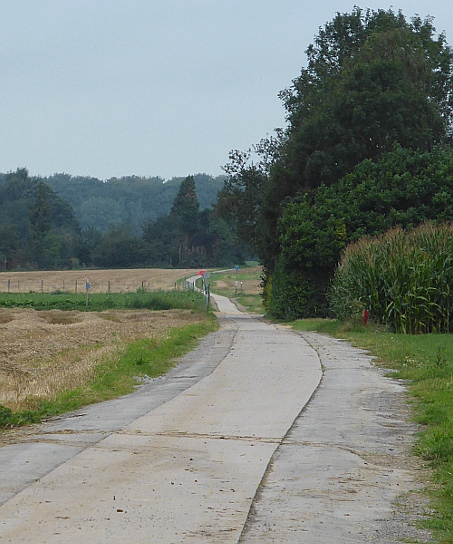
Narrow concrete tracks across farm land and rolling orchards were quite common and delightfully quiet. We followed dirt tracks surrounded by trees and wonderful purple heather.Flanders cycling photo Kevin Mayne Off road cycle route cycling Flanders

Urban cobbles, floral bridges and giant canals with the smoothest, widest cycle paths imaginable.

Photo by Kevin Mayne Photo by Kevin Mayne

Flanders cycle routes

Even a motorway bridge at one point. You have got to love the Dutch, they do build bike paths on an industrial scale!

Cycle route motorway bridge

7. It is always worth ten minutes more at the café.

When one person really wants to go and look at the bravest of the Gauls, the Belgae warrior Amborix whose statue was rather too like comic book hero Asterix to be taken seriously then the other person is equally free to take a second coffee.

Cycling in Flanders

And conveniently on this trip every time we took a bit longer it started to rain, but in this year’s Belgian summer it was soon gone again soon. We rode on a lot of wet roads, but only in a bit of drizzle in the whole 3 days. Very, very lucky.

Geoff Mayne by Kevin Mayne

And finally item 8.

Go home while you are still having fun.

Cycling in Flanders Kevin Mayne

When we set out we didn’t actually decide whether we were going for two days or three. The weather was probably going to be the defining factor, but we both knew that we had to work out whether we were going to enjoy each other’s riding style and the route.

At the lunch stop in Maastricht a conversation took place that roughly said “when are we going to get the chance to do something as good as this again?” and the matter was very quickly decided in favour of the extra day. Unanimously.

*Knooppunt are a system of nodes or junctions on a network of recommended cycle touring roads, paths or route sections.

They are all numbered and you plan your route by selecting a sequence of numbers that you want to connect on a map, on-line or on a GPS unit. The excellent signposting takes care of the rest as each road or trail junction has a signpost pointing to the relevant numbers. They started in the Netherlands, now cover Flanders and are gradually beginning to appear in specific areas of Germany and Wallonia.

Where we went the Dutch and Flemish signs linked up over the border – so useful.

Some more information here.


“It’s the end of the world as we know it. (And I feel fine.)” A special last ride in New Zealand. Thanks to everyone that made the cycling on this trip possible.

Bluff Point sign

So this was the final day of my six weeks in Australia and New Zealand. It has taken me almost that long again to write it all up, but the last day’s ride was so good it feels vivid and fresh right now.

It was not only a symbolic end, I physically reached the end of New Zealand’s South Island, spending my last morning riding on Bluff Hill, a rocky dome of a hill that rises 265 m (870ft) straight from sea level at the very southern tip of New Zealand’s South Island. It has 360 degree panoramic views along the coast, inland towards Invercargill and even to the mountains far beyond. The Maori name for the hill is Motupõhue which means “island of põhue flowers”, because from the sea it appeared to be an island rising before the rest of the land could be seen. Despite its remote location Bluff has a claim to be the longest permanently settled European town in New Zealand, the first trader and farmer bought land off the Maori here in 1824. Today it is still an active port although many Kiwis will be much more interested in the seasonal Bluff Oysters, considered the finest of delicacies and craved by exiles.

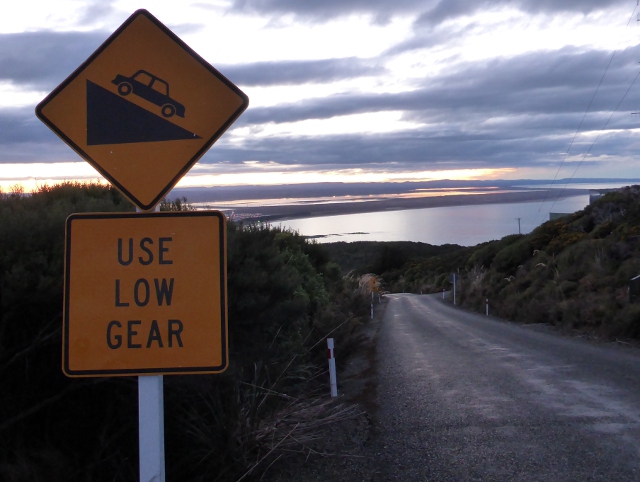
I knew about Bluff Hill from my previous trips to Invercargill. Everywhere has a hill like this. The one you have to go and try when you think you have become a cyclist. The local cyclists talk about it in that tone that tells you it is a place of legend. When you are even part way up your legs are burning and you are frantically looking for a lower gear that you don’t have any more. Bluff Hill’s reputation is enhanced because the Tour of Southland, New Zealand’s toughest bike stage race regularly finishes at the top.

Flagstaff Road Bluff New Zealand

However I had never actually cycled there on my previous trips, mainly because it is 25 km south of Invercargill and the access is an open stretch of main road that I had never fancied riding. However this time I was updating my knowledge about what was going on locally when I saw a link to Bluff Hill trails on the Southland MTB Club web site.

Within moments I knew that this was a “must do”. A bucket list item almost. To know I had ridden on what is possibly the most southerly set of planned and maintained mountain bike trails in the world? To ride up above the countryside and sea and take in the landscape at this unique place. To know I could spend an hour or more playing on good mountain bike trails rather than just head-banging down a main road. You bet I was going to try and go there.

I hadn’t really planned on it being the last day but that is the way that time escapes on a short visit. So to maximise family time and get in my special ride I compromised and got up at 6am to drive my in-laws’ car out to the foot of the hill, ready to ride at first light.

Bluff Hill Flagstaff Road in the dark New ZealandThat part of the plan went perfectly. Too perfectly. I arrived just as there was a glimmer of dawn on the far horizon, but I couldn’t actually see a yard in front of my face at the trailhead so any prospect of riding up the hill off-road had to wait.

Instead I took the route of most pain and climbed the almost straight road to the top of the hill. It is 22% at the steepest point and an average of 11% so I certainly needed the mountain bike gears, doing that without any sort of warm up at 7.30 am in the morning would have had me walking for sure on a road bike.

But then my timing turned out to be absolutely perfect. As the light crept in under the clouds the landscape changed magically, second by second. Each time I lifted my head deep blues turned to pinkish hues behind me and the road surface became more visible.

Bluff Hill view New Zealand

Buff Hill sunrise New Zealand

Dawn from Bluff Hill mountain bike tracks New Zealand

As I got to the top a soft yellow glow was driving away the shadows right across the landscape.

Bluff Hill Sunrise over south coast of New Zealand

Way in the north Invercargill was visible a series of light spots on the flat plain.

Lights at dawn Invercargill from Bluff Hill New Zealand

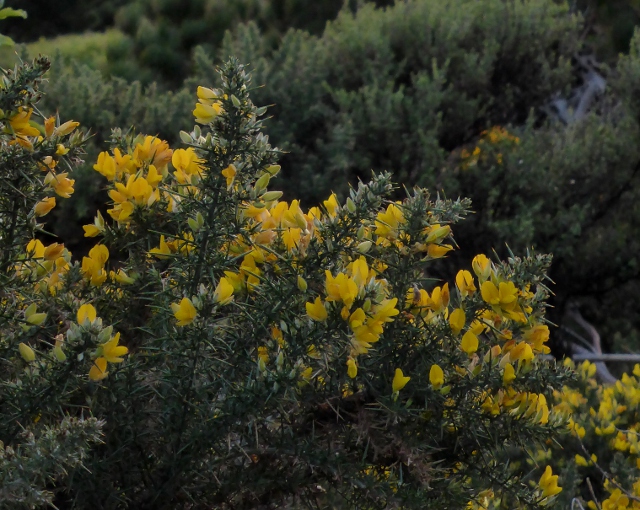
I was also blessed by the weather. The start of winter and I was wearing a light cycling top and shorts in almost windless conditions, an incredible stroke of luck for the views and the riding. Despite it being winter clumps of hardy gorse were in bloom, the yellow flowers seemingly sucking up the rays and glowing against the grey-green backdrop.

Gorse flowers on Bluff Hill New Zealand

I don’t know how long I hung around at the top taking in the rising sun and the changing views but I had to pinch myself to remember I was there to ride as well.

Bluff Hill viewing point at dawn

I looked momentarily at the entrance point to the “Downhill route” which descends a terrifying straight line and is graded “Black” or “expert”, but knowing that it was not for me I dropped down the shallower side of the hill and played for an hour on the intermediate trail network. It weaved its way up, down and around the hillside, offering me a good variety of riding. But what made this set of trails special today was that every corner offered a different sea view, and when I was sure I had gone round a section more than once it didn’t really matter because the effect of the sunrise was to make it feel subtly different each time.

Bluff Hill Mountain Bike Trails New Zealand Bluff Hill Mountain bike tracks New Zealand Bluff Hill Mountain bike track with sea view New Zealand

All the time in my head I was revelling in where I actually was, at the far end of the world and at the end of my holiday. Throughout the ride a song played in on permanent repeat in my head. REM’s “It’s the end of the world as we know it” was the song of the day. Inevitably? Maybe, in the odd way my mind works.

Then time was up and I let the bike flow its way down the lumps and bumps in the track to the parking where mine was still the only car, another joy of riding on a winter dawn. It was indeed the end of the trip, and fate intervened to tell me so in no uncertain terms. As I freewheeled into the car park there was a horrible rending noise, all pedalling ceased and I looked down to discover a very distressed gear mechanism in quite the wrong position. My last seconds, my last ride and my only mechanical failure of the whole trip.

Time to go home, but what a way to finish.

My huge thanks to everyone who made the cycling on this trip possible. The mountain bike trail builders of New Zealand and the local authorities building bike paths all over Australia and New Zealand. The friends, family and commercial companies that made it possible to beg, borrow and hire eight different bikes in six weeks. Jason I am really sorry about the last day mishap on your nice mountain bike – I hope you have it fixed now.

Last and by no means least the family, friends and hosts who indulged me once again while I went off at all times of the day to get my cycling fix. I had come to see you all, of course, but a bit of pedalling made me a nicer human being – trust me. As my favourite travelling companion knows best of all.

If you cannot see a link to the REM song here in the email version of the post click “View in Browser” for a working link.